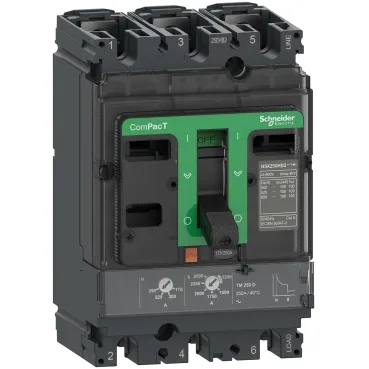
What the 200 A TM-D trip unit means for your panel
The C25V3TM200 is a Schneider Electric ComPacT NSX250HB1 moulded-case circuit breaker with a 200 A thermal-magnetic trip unit (TM-D) in a 3-pole, 3-protected-pole configuration. The TM-D provides L protection (thermal overload) and I protection (magnetic short-circuit), both adjustable via the trip unit dials. For a distribution panel feeding a 200 A bus, this breaker sits as the main or a large feeder — the thermal element tracks RMS heating, the magnetic element clears bolted faults before the let-through energy damages downstream gear.
Breaking capacity — the number that decides coordination
Rated 85 kA Icu at 500 V AC 50/60 Hz, 80 kA at 525 V, and 75 kA at 660/690 V per IEC 60947-2. For a 200 A frame, 85 kA is well into industrial-grade territory — you can coordinate it downstream of a transformer feeding a 2000 A switchboard and still hold selectivity.
Mounting and fit — backplate, not DIN rail
Mounts flat on a backplate, not a DIN rail. The 105 mm width, 161 mm height, and 86 mm depth match the standard ComPacT NSX cutout. Horizontal or vertical orientation is allowed — useful when the gland plate forces a 90-degree rotation. IK07 impact rating handles the odd dropped screwdriver during commissioning.
Lifecycle and sourcing — active, no obsolescence watch needed
Listed as current production. No LTB notice, no successor number to track. For a critical-spare buyer, this is the one to keep in the cabinet — the TM-D trip unit is field-proven across thousands of NSX installations, and the 200 A rating covers a common feeder size. If you are freezing a BOM for a new panel, the C25V3TM200 is a standard catalogue item, not a phase-out risk.
What the standards tell you
Certified to EN/IEC 60947-2, with suitability for isolation marked on the nameplate. Overvoltage category III covers fixed-installation distribution, not just the load side of a transformer.
Durability and dissipation — real-world panel loading
Mechanical endurance is 20,000 cycles; electrical endurance at 440 V In is 10,000 cycles. Power dissipation per pole is 15.4 W — three poles at full load generate about 46 W of heat inside the enclosure. For a sealed panel with no forced ventilation, that heat must be factored into the ambient derating curve.