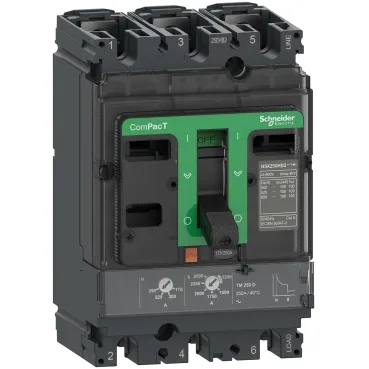
That 250 A is the frame size and the trip rating — it carries 250 A of load current without nuisance tripping, and the TM-D provides L (thermal) overload protection plus I (magnetic) short-circuit protection. The headline breaking capacity is 85 kA Icu at 500 V AC 50/60 Hz per IEC 60947-2, which means it can safely interrupt a fault current up to 85,000 A at that voltage without welding contacts or rupturing the case. For a distribution panel feeding a 250 A bus, that gives you real fault-current headroom — you can coordinate downstream breakers without worrying about the main blowing first.
Mounting and integration into a switchboard
Mounts flat on a backplate — no DIN rail here, so plan for a drilled panel or a mounting plate with the 35 mm connection pitch. Both line and load connections are front-facing, which simplifies busbar routing and cable landing. The breaker can be mounted horizontally or vertically, giving flexibility in tight enclosures. IK07 impact rating means it survives a 2 J hammer blow (roughly a dropped tool).
Durability and thermal budget
Mechanical endurance is 20,000 cycles — that's the handle life. Electrical endurance depends on the load: 20,000 cycles at 440 V at half rated current, 10,000 cycles at full 440 V, and 5,000 cycles at 690 V. For a main breaker that operates once or twice a day, that's decades. Each pole dissipates 18.75 W at rated current, so three poles total 56.25 W of heat inside the enclosure. Factor that into your thermal calculation — if the panel is sealed or tightly packed, you may need ventilation or a larger cabinet to stay below 40 °C ambient at the breaker terminals.