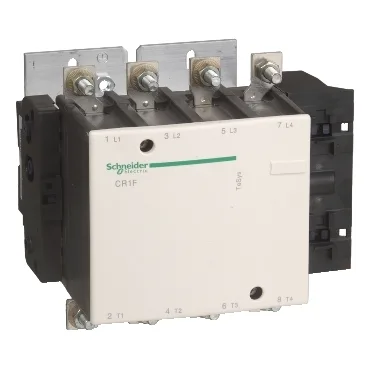
The coil is bistable: it latches and unlatches with a pulse, not continuous power. Latching takes 35–40 ms, unlatching 50–100 ms. Average consumption peaks at 1100 VA AC 50/60 Hz during latching, then drops to 7.3 VA AC 50/60 Hz unlatching — so the control transformer only needs to supply the pulse, not hold-in current. The control voltage limits are 0.85 to 1.1 Uc for both latching and unlatching, which means the coil will reliably operate with a 48 V supply between about 41 V and 53 V.
This contactor is panel-mounted, sized at 301 mm high, 201.5 mm wide, and 171 mm deep — a substantial footprint that needs generous enclosure space and clearance for the arc chutes. The 4-pole configuration with all NO contacts suits it for switching three-phase power plus a neutral, or two independent resistive loads. The rated breaking capacity varies by voltage: 1500 A at 220–440 V, 1200 A at 500 V, 1100 A at 600–690 V, and 450 A at 1000 V — so the interrupting capability drops as voltage rises, which is typical for air-break contactors. The associated fuse ratings are 160 A aM (motor protection) or 250 A gG/BS88 (general purpose) for the power circuit — these are the maximum fuse sizes that coordinate with the contactor's short-circuit withstand. The mechanical durability is 1,000,000 cycles, and the maximum operating rate is 120 cycles per minute at 40 °C, so it can handle frequent switching in resistance welding or furnace control applications.