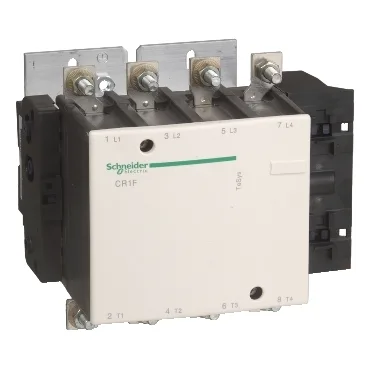
Its 48 V DC low-consumption coil holds the contacts latched without continuous power draw, making it suited for applications where sustained coil energization is undesirable or where backup power must be conserved. The contactor carries a conventional free air thermal current (Ith) of 250 A at 104 °F (40 °C) and a rated operational voltage (Ue) of 1000 V AC at 25 to 200 Hz. Motor power ratings span 40 kW at 220...230 V AC up to 100 kW at 690 V AC, with UL/CSA horsepower equivalents from 40 hp at 200...208 V to 125 hp at 575...600 V. The rated operational current (Ie) is 150 A at 250 A under AC-4 duty at ≤ 440 V and 104 °F (40 °C). Utilisation categories include AC-1 (resistive), AC-3 (squirrel-cage motor starting), and AC-4 (plugging/inching), so it covers both standard motor starting and more demanding reversing or jogging applications.
The contactor measures 6.7 in (171 mm) deep, 7.9 in (201.5 mm) wide, and 6.7 in (170 mm) high. It connects via lugs, ring terminals, or bars, with a tightening torque of 159.3 lbf·in (18 N·m) on the main power terminals. The 4 NO power pole configuration and 48 V DC latching coil (operating limits 0.85...1.1 Uc) simplify wiring in a control panel where a separate DC supply is already present. Operating altitude is 9842.52 ft (3000 m) without derating, and the ambient temperature range for operation is 5 to 158 °F (-15 to 70 °C).
The rated breaking capacity reaches 1500 A at 220...440 V, dropping to 450 A at 1000 V — this is the maximum fault current the contactor can safely interrupt, not its continuous rating. The rated short-time withstand current (Icw) is 1200 A for up to 10 seconds at 104 °F (40 °C), which means it can ride through brief overloads without welding its contacts. Associated fuse ratings are 160 A aM or 250 A gG at ≤ 440 V, and 250 A BS88. Power dissipation per pole is 6 W under AC-3 duty and 18 W under AC-1, which should be factored into enclosure thermal calculations.