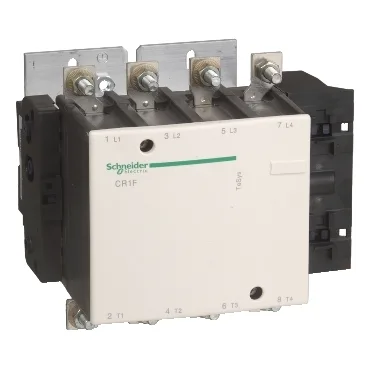
The CR1F1504N7 is a TeSys F magnetic contactor from Schneider Electric — a 4-pole (4 NO) latching contactor rated for 250 A conventional free-air thermal current (Ith) at 40 °C, with an AC-1 rated operational current of 150 A at <40 °C for the power circuit. The control circuit runs on 415 V AC 50/60 Hz, with latching and unlatching voltage limits of 0.85 to 1.1 Uc. This is a heavy-duty contactor sized for resistive loads in industrial power distribution and switching panels.
The 250 A Ith rating tells you the contactor's thermal capacity in free air — the current it can carry continuously without exceeding temperature rise limits. The AC-1 utilisation category means this rating applies to resistive or slightly inductive loads (heating, lighting, distribution), not motor starting. For motor duty you'd need an AC-3 rating, which this part does not carry. The 150 A operational current at <40 °C is the practical working limit for the power circuit under AC-1 conditions. Coil consumption is substantial: 1100 VA inrush on latching at 50/60 Hz, dropping to 7.3 VA holding. The latching mechanism means the coil only draws power during the switching transition — once latched, the contactor holds magnetically without continuous coil power, which reduces heat in the panel. Operating time is 35 to 40 ms to latch, 50 to 100 ms to unlatch. The contactor is rated for power circuit voltages up to 1000 V AC and 1000 V DC, with a rated insulation voltage of 1000 V (1500 V per VDE 0110 group C). Breaking capacity reaches 1500 A at 220 to 440 V, tapering to 450 A at 1000 V. The associated fuse recommendations are 160 A aM or 250 A gG/BS88 for the power circuit.
Where this class of part is used
TeSys F contactors like this one are installed in industrial control panels for switching power circuits — typically feeding resistive loads such as industrial heaters, lighting banks, or capacitor banks. The 4-pole configuration with all NO contacts suits three-phase plus neutral switching or dual-circuit distribution. The latching (bistable) design is chosen where continuous coil power is undesirable or where the contactor must hold its state through a control voltage loss.