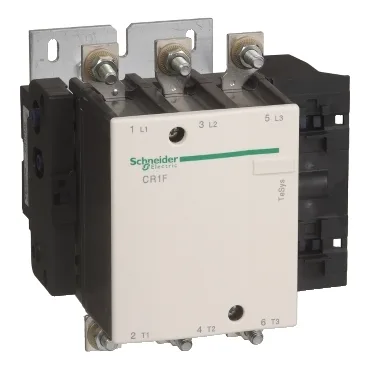
That low-hold characteristic makes it a fit for applications where sustained coil power is undesirable or where a power loss must not drop the load. Motor power capacity ranges from 40 kW at 220 V AC up to 100 kW at 690 V AC, 50/60 Hz. The contactor handles resistive loads (AC-1) and standard motor starts (AC-3) as well. The 220 V DC control coil operates within 0.85 to 1.1 times its rated voltage for both latching and unlatching. Operating time is 35 to 40 ms to latch, 50 to 100 ms to unlatch. Mechanical durability is rated at 1 million cycles.
AC-4 involves making and breaking locked-rotor current, so the contactor sees severe arc stress. The 150 A figure tells you this part can handle a 150 A motor load under those conditions, not just a 250 A resistive heater bank. Rated insulation voltage is 1000 V per IEC 60947-4 and BS 775, with an impulse withstand of 8 kV. That means it's rated for 690 V line-to-line systems with margin — typical for 400 V to 690 V industrial networks. Short-time withstand current (Icw) is 1200 A for up to 10 seconds at 40 °C, tapering to 350 A for 10 minutes. This is the rating that matters for coordination with upstream protective devices — the contactor must survive until the fuse or breaker clears a fault. Associated fuse recommendations are 160 A aM or 250 A gG at up to 440 V. Power dissipation per pole is 6 W in AC-3 duty and 18 W in AC-1. The contactor is rated for operation from -15 °C to 70 °C ambient and storage from -60 °C to 80 °C, with no derating up to 3000 m altitude.
This is a panel-mount contactor, not a DIN-rail snap-on. It's sized for bolted connections: terminals accept lugs, ring terminals, or bars — up to 120 mm² cable per pole, or dual 25 x 3 mm bars. Tightening torque is 18 N.m (159 lbf.in). The 6.7-inch depth (171 mm) and 6.4-inch width (163.5 mm) mean it needs a backplate or mounting bracket, not a DIN rail. Typical deployment is in motor control centers or standalone starter enclosures for pumps, conveyors, compressors, and fans — any 3-phase motor load up to 100 kW at 690 V. The latching feature suits applications where a momentary control signal sets the state and holds it without continuous coil power, such as remote or battery-backed installations.
No direct successor or cross-reference is listed in the official lifecycle data. If you need a substitute, the TeSys F family includes other frame sizes and coil voltages, but pin-compatibility and mounting footprint must be verified against the specific application. The CR1F150MZ7 is the variant with a 220 V DC low-consumption coil.