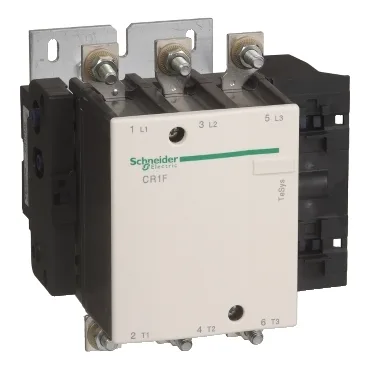
Rated 185 A operational current (AC-4) and 90 kW at 400 V AC 50/60 Hz, it handles heavy motor loads — think large pumps, compressors, or conveyors — where the contactor must stay closed without continuous coil power. The magnetic latching mechanism holds the main poles engaged using a pulse of 48 V AC or DC, then drops to a low holding power; unlatching also uses a pulse. This cuts coil heat and standby losses, useful in applications where the contactor stays closed for long periods.
For less severe AC-3 motor starting, the contactor can handle higher currents (275 A Ith at 50 Hz). The 90 kW at 400 V AC-4 tells you it can reverse or stop a 90 kW motor on a 400 V line without welding the contacts. Coil is 48 V AC 50...400 Hz or 48 V DC, with a latching pulse of 1750 VA (AC) or 1750 W (DC), then just 11 VA/W to hold. That pulse is brief — 35...40 ms to latch, 50...100 ms to unlatch — so the control transformer must deliver the inrush without sagging. Rated insulation voltage is 1000 V per IEC 60947-4, and the contactor can break 1800 A at 220...440 V, so it coordinates with upstream fuses up to 315 A gG. Mechanical durability is 1 million cycles, typical for this frame size.
This is a panel-mounted contactor, not DIN-rail snap-on. The power circuit uses bolted connections — bars, lugs, or ring terminals up to 150 mm². Tightening torque is 18 N.m (159.3 lbf.in) on the main terminals. Dimensions are 7.1 in deep, 6.6 in wide, 6.9 in high — it takes up a standard footprint for a 185 A frame. Operating altitude is 3000 m without derating, and ambient temperature range is -15 to 70 °C. For food-and-bev or washdown areas, note the protective treatment is TC (tropicalized coating), but the contactor itself is not IP-rated — it belongs in a sealed enclosure.