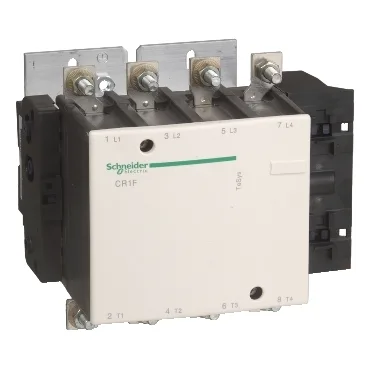
The CR1F2654G7 is a TeSys F magnetic latching contactor — a 4-pole, 4-NO device rated for motor control and resistive loads. The magnetic latching mechanism holds the closed position without continuous coil power, which cuts standby consumption and heat in the panel. Control voltage is 127 V AC (50–400 Hz) or 127 V DC standard, with a latching coil draw of 1800 VA AC or 1800 W DC and an unlatching draw of 12 VA/W. The operating time is 40–75 ms latching, 50–100 ms unlatching. This is a part for applications where a sustained hold-in coil is undesirable — think battery-backed or UPS-fed circuits, or panels where coil heat must be minimized.
The same contactor carries an AC-1 resistive rating of 350 A at ≤ 440 V, and an AC-4 rating of 245 A — the AC-4 figure matters for reversing or inching duty where the contactor makes and breaks stalled-rotor current. For UL/CSA markets, the motor power equivalents are 150 hp at 460–480 V and 175 hp at 575–600 V three-phase. Rated breaking capacity is 2450 A at 220–440 V for the power circuit, with a making capacity of 2940 A. That gives headroom for starting inrush on motors within the rated range. The associated fuse recommendation is 315 A aM or 400 A gG at ≤ 440 V — coordinate the upstream protection to the contactor's breaking capability, not the motor FLA alone. Power dissipation per pole is 22 W in AC-3 and 39 W in AC-1. In a closed panel with multiple contactors, that heat adds up — the 0.32 mOhm average impedance at 350 A 50 Hz gives you the resistive loss to calculate for your thermal budget. Rated insulation voltage (Ui) is 1000 V per IEC 60947-4 and BS 775, with a VDE 0110 group C rating of 1500 V. Ambient operating range is -15 to 70 °C, storage -60 to 80 °C.
Dimensions are 8.4 in deep, 9.6 in wide, 8.0 in high — a substantial footprint that needs clearance for the lug/ring terminal connections (accepts up to 240 mm² cable or two 32 x 4 mm bars). Tightening torque is 35 N·m on the power terminals. IP20 front-face protection per IEC 60529; the contactor is intended for inside an enclosure.