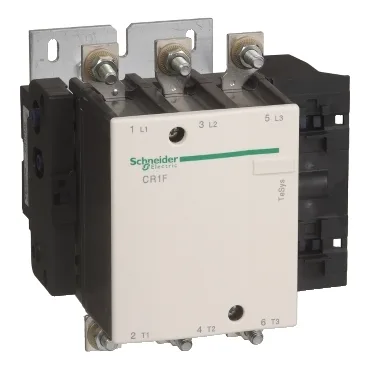
The Schneider CR1F265PF7 is a TeSys F magnetic latching contactor, a 3-pole (3 NO) device rated for 265 A operational current in AC-4 duty, meaning it handles the demanding inrush and plugging cycles of motor reversing or jogging applications. The latching mechanism holds the main contacts closed without continuous coil power — the coil draws 1800 VA only during the latching pulse (40...75 ms), then drops to 12 VA for the unlatching pulse (50...100 ms). This makes it suitable for applications where sustained coil dissipation is undesirable, such as in warm enclosures or on UPS-backed control circuits where every VA counts.
The headline rating is 265 A at ≤440 V AC in AC-4, which governs motor reversing and inching duty. For resistive loads (AC-1), the contactor can carry 350 A thermally (Ith) with an average impedance of 0.32 mΩ per pole, so voltage drop across the contacts stays under 0.1 V at full load — relevant for low-voltage-drop circuits like heater banks. Rated insulation voltage is 1000 V per IEC 60947-4, so it can be used on 690 V line-to-line systems with adequate clearance.
This is a bolted-contact device, not a DIN-rail snap-on. Power connections accept lugs, ring terminals, or bars — the busbar cross-section can go up to 32 x 4 mm, and the bolted connection torque is 35 N·m. The footprint is 201.5 mm wide by 203 mm high by 213 mm deep, so plan for a backplate or mounting bracket that clears adjacent devices. The control circuit accepts both AC (50...400 Hz) and DC at 230 V or 110 V nominal, with a tolerance band of 0.85...1.1 Uc for both latching and unlatching. That means a 230 V AC coil will reliably pick and drop between 195.5 V and 253 V.
Protection and coordination
For short-circuit coordination, the associated fuse ratings are 315 A aM or 400 A gG at ≤440 V, or 400 A BS88. The rated short-time withstand current (Icw) is 2200 A for 1 second at 40 °C, which gives selectivity headroom for downstream motor starters.
Environmental limits
The protective treatment is TC (tropicalized coating), which resists humidity and mild corrosive atmospheres typical of industrial environments.