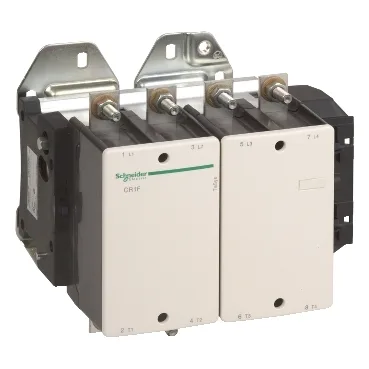
The headline rating is 500 A AC-1 at 40 °C for the power circuit — that's the current it can carry continuously in a resistive heating or lighting bank, not motor starting. The conventional free-air thermal current Ith is 700 A at 40 °C, which is the thermal limit of the contact structure; you size the upstream protection to that, not the operational current. Coil is a standard latching type at 48 V, available in AC 50/60 Hz, AC 400 Hz, or DC, with a hold-in range of 0.85 to 1.1 Uc. Latching time is 40 to 80 ms, unlatching 50 to 100 ms — that's the mechanical response, not including arc extinction. The control circuit impedance is 0.18 ohm at 50 Hz, so inrush current on the coil is significant; verify your control transformer can handle the 1650 VA latching peak at 50/60 Hz.
This is a panel-mount contactor, not DIN-rail snap-on. At 288 mm wide by 400 mm tall by 232 mm deep, it's a substantial piece of iron — plan for a backplate or sub-panel with adequate clearance for arc chutes and cable bending radius. The operating position tolerance is ±5° from vertical, so it needs to be mounted plumb; a tilted panel shifts the magnetic blowout performance. The TH protective treatment means it's tropicalized for humidity and fungus — relevant for coastal or unconditioned electrical rooms.
Breaking capacity and protection coordination
Rated breaking capacity varies with voltage: 5000 A at 220 to 440 V, 4500 A at 500 V, 3560 A at 600 to 690 V, and 2500 A at 1000 V for the power circuit. The making capacity (Irms) is 5000 A, so it can close into a fault without welding. For short-circuit protection, the associated fuse ratings are 800 A gG or BS88, or 500 A aM per pole. The 800 A gG is for general-purpose backup; the 500 A aM is for motor-circuit coordination if that's your application, though this contactor is AC-1 rated, not AC-3. Power dissipation per pole is 88 W at AC-1 — that's 352 W total across four poles at full load, so panel ventilation matters.
Mechanical life and operating limits
Mechanical durability is 1,000,000 cycles — that's the expected life of the mechanism before wear-out, not the electrical life under load. Maximum operating rate is 120 cycles per minute at 40 °C, which is fast enough for repetitive switching like resistance welding controls or capacitor bank cycling. Ambient air temperature range is -15 to 70 °C; below -15 °C the coil may not pick reliably, and above 70 °C you need to derate the current. The rated insulation voltage Ui is 1000 V per IEC 60947-4 and BS 775, with a 1500 V rating per VDE 0110 group C — that's the voltage the creepage and clearance are designed for, not the operational voltage.