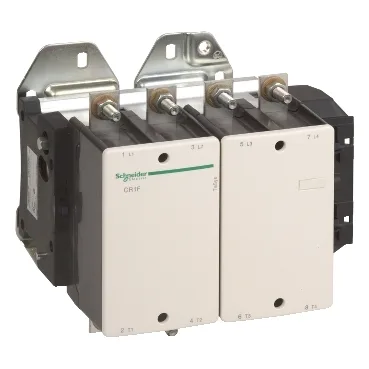
It's a bistable (latching) contactor — meaning the coil only needs power to change state, not to hold it — which cuts continuous power draw and heat in the panel. The 127 V AC/DC control coil covers both 50/60 Hz and 400 Hz supplies, so you can use the same part across different line voltages without swapping coils. For motor switching (AC-3), the rated operational current is 500 A. The contactor is rated for 1000 V AC and 1000 V DC on the power circuit, with a rated insulation voltage of 1000 V conforming to IEC 60947-4 and VDE 0110 group C. That puts it squarely in industrial switchgear territory — suitable for 690 V line-to-line systems common in heavy industry.
The rated breaking capacity tells you how much fault current this contactor can interrupt safely: 5000 A at 220–440 V, 4500 A at 500 V, 3560 A at 600–690 V, and 2500 A at 1000 V. That's the contactor's own capability — you still need upstream fuses or a breaker for full short-circuit protection. The associated fuse ratings are 800 A gG or 800 A BS88 for the power circuit, or 500 A aM. Match those to your coordination study. Mechanical durability is 1,000,000 cycles. That's a solid figure for a contactor this size — expect it to outlast the equipment it controls in most cyclic applications.
If you're replacing an older TeSys F contactor with a different coil voltage, the CR1F5004G7's 127 V AC/DC coil covers a wide range — just verify your control voltage matches the 0.85–1.1 Uc limits.
Mounting position tolerance is ±5° from vertical — not critical for most panels, but worth noting if you're installing in a mobile or tilted enclosure. The protective treatment is TH (tropicalized), meaning it's treated against humidity and fungal growth — a good fit for warm, damp environments like Southeast Asian factories or coastal plants. The control circuit impedance is 0.18 Ω at Ith 700 A, 50 Hz. That low impedance means the coil draws significant inrush current during latching — 1450 VA at 50/60 Hz, 1600 VA at 400 Hz, and 1600 VA DC. Make sure your control transformer or DC supply can handle that peak without voltage sag. The unlatching consumption drops to 12 VA AC or 16 VA DC, so the steady-state load is minimal. Operating time is 40–80 ms for latching and 50–100 ms for unlatching. That's typical for a large DC-operated contactor — not fast enough for arc-flash mitigation, but fine for motor starting and load switching. The ambient temperature range of -15 to 70 °C covers most industrial environments, though you'll want to derate the continuous current above 40 °C.