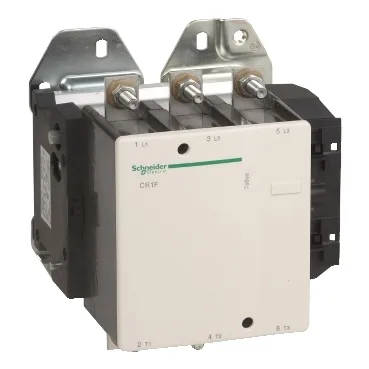
It's rated for motor control and resistive loads across utilisation categories AC-1, AC-3, and AC-4. The headline rating is 500 A in AC-4 duty at ≤440 V (the severest category, for plugging and inching of motors), with a 700 A rating in AC-3 at the same voltage. That translates to 335 kW at 690 V AC or 280 kW at 400 V AC, which covers large pumps, compressors, or conveyor drives on a 690 V industrial network.
The AC-4 current of 500 A is the number that governs the real-world switching of reversing or jogging motor loads — the heavier the duty cycle, the more this rating matters over the AC-3 figure. For resistive loads (AC-1), the contactor is rated at 700 A Ith, with a power dissipation of 88 W per pole under that load. The control circuit is 415 V AC 50/60 Hz, with a latching coil draw of 1800 VA and unlatching at 13 VA. The operating time is 40–80 ms to latch, 50–100 ms to unlatch. That latching pulse is brief but substantial — the coil supply needs to handle that inrush without sag. The associated fuse recommendation is 500 A aM or 800 A gG/gG-type up to 440 V.
This is a panel-mount contactor sized for a notched AM1-EC rail — the mounting support is specific, not a standard DIN rail. At 9.1 in deep, 9.2 in wide, and 9.4 in tall, it needs a generous enclosure. The terminals accept lugs or ring terminals up to 240 mm², or bars 40 x 5 mm, torqued to 35 N·m.
The CR1F500N7 carries compliance with IEC 60947-4, JEM 1038, VDE 0660, BS 5424, and NF C 63-110. Rated insulation voltage is 1000 V per IEC 60947-4 and 1500 V per VDE 0110 Group C. The protective treatment is TH (tropicalised) for humid environments.