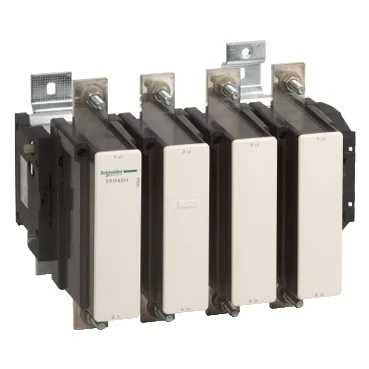
Its 630 A rated operational current (Ie) at 1000 V AC and motor power capability up to 450 kW at 690 V AC place it squarely in heavy-duty applications — large pumps, compressors, conveyors, or furnace control where a sustained coil hold would be wasteful or thermally problematic. The magnetic latching mechanism means the contactor stays closed without continuous coil power; a DC pulse latches it, a reverse pulse unlatches it. Average consumption is 620 W during the latching pulse and 45 W during unlatching — no holding power once the state is set.
Rated for utilisation categories AC-1 (resistive), AC-3 (squirrel-cage motor starting/running), and AC-4 (plugging, inching, reversing). The 630 A figure is the AC-4 rating at ≤440 V — the most demanding duty, where the contactor must break motor inrush and reversal currents. For AC-3 motor starting, the conventional free-air thermal current (Ith) is 1000 A at 40 °C, which gives headroom for less severe switching. Rated breaking capacity reaches 6300 A at 220–440 V, dropping to 3200 A at 1000 V. This is the fault current the contactor can safely interrupt once — it is not a short-circuit protection device, but it must coordinate with upstream fuses (630 A aM or gG per the spec) to survive a fault without welding. Rated short-time withstand current (Icw) of 5050 A for 1 second defines how long the contactor can carry a fault before the upstream protection clears. At 30 seconds the Icw drops to 4400 A — relevant for selective coordination studies where delayed trips are used. The 220 V DC control circuit operates between 0.85 and 1.1 Uc (187–242 V DC). The latching pulse must be within this window; below 187 V the contactor may not latch reliably, above 242 V risks coil damage. Operating time is 40–80 ms latching, 50–100 ms unlatching. Rated insulation voltage (Ui) is 1000 V per IEC 60947-4 and BS 775, with impulse withstand (Uimp) of 8 kV. Power dissipation per pole is 48 W in AC-3 duty and 120 W in AC-1. For a 4-pole contactor running at rated current, that is 192 W (AC-3) to 480 W (AC-1) of heat inside the enclosure — factor this into cabinet ventilation and derating, especially if grouped with other heat sources.
This class of contactor — a high-current magnetic latching type — is specified in applications where continuous coil power is undesirable: UPS bypass circuits, solar combiner boxes, battery energy storage systems, and industrial processes where a contactor must hold its state through a control-power loss. The 4-pole NO configuration with bar terminals (2 bars of 60 x 5 mm) is sized for bolted busbar connections typical in switchgear and motor control centres. The TH protective treatment and operating temperature range of -15 to 70 °C allow deployment in tropical or unconditioned enclosures, while the 3000 m altitude rating without derating covers most high-altitude installations.