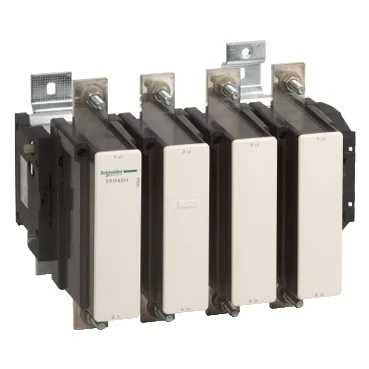
The Schneider Electric TeSys F CR1F6304N7 is a 4-pole magnetic latching contactor rated for 630 A operational current at up to 1000 V AC. The latching mechanism holds the main poles in position without continuous coil power; unlatching requires a separate pulse. That 630 A figure is the rated operational current (Ie) in AC-3 duty for motor switching; the same contactor carries 1000 A in AC-1 resistive load service, so the actual current you can switch depends on the load type. Motor power capability spans from 200 kW at 220–230 V AC up to 450 kW at 690 V and 1000 V AC (50/60 Hz). Under UL/CSA ratings, it handles 800 hp at 575–600 V for three-phase motors. That's a big contactor — sized for large pumps, compressors, conveyors, or any motor load where you need a single switching device rather than paralleling smaller units.
For resistive loads (AC-1), the same contactor is good for 1000 A, which is the thermal current (Ith) rating. The utilisation categories AC-1, AC-3, and AC-4 cover the full range from resistive heating banks through standard squirrel-cage motor starting to plugging and inching duty. Breaking capacity is substantial: 6300 A at 220–440 V, tapering to 3200 A at 1000 V for the power circuit. That's the fault-clearing capability the contactor can handle without welding its contacts — relevant for coordination studies where the contactor sits downstream of a fuse or breaker. The associated fuse recommendation is 630 A aM or gG type, which sets the short-circuit protection boundary. Control circuit voltage is 415 V AC 50/60 Hz, with latching and unlatching both requiring 0.85 to 1.1 times Uc. The coil draw spikes at 2300 VA during the latching pulse, then drops to 11 VA for the unlatching pulse — that's a momentary surge, not continuous. The operating time is 40–80 ms to latch and 50–100 ms to unlatch, which matters if you're sequencing contactors in a transfer scheme.
This contactor mounts on a notched AM1-EC rail — that's a heavy-duty mounting channel, not a standard DIN rail. The dimensions are substantial: 389 mm wide, 304 mm high, 255 mm deep. Panel layout needs to account for the bar-type terminals (2 bars 60 x 5 mm) and the tightening torque of 58 N.m on the power connections. The TH protective treatment indicates it's tropicalised for humidity resistance. Maximum operating rate is 120 cycles per hour at 40 °C, and mechanical durability is rated at 1 million cycles — so it's built for a long service life in continuous-duty applications.