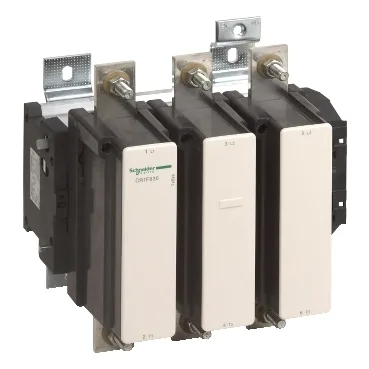
The Schneider Electric CR1F630E7 is a TeSys F bistable magnetic contactor, 3-pole, rated 630 A in AC-3 duty at 440 V — meaning it handles heavy motor switching loads like conveyors, pumps, and compressors in industrial control panels. The coil is 48 V, accepting AC 50/60 Hz, AC 400 Hz, or DC, with latching consumption of 1450 VA (AC 50/60 Hz) or 1600 VA (DC), and unlatching at 12 VA (AC 50/60 Hz) or 16 VA (DC). That wide coil tolerance simplifies panel wiring where multiple control voltages exist.
Rated operational voltage covers power circuits up to 1000 V AC and 1000 V DC, so it suits both standard 400 V three-phase and higher-voltage installations like 690 V mining or marine systems. Breaking capacity varies by voltage: 6300 A at 220...440 V, 5400 A at 500 V, 4600 A at 660/690 V, and 3200 A at 1000 V. Associated fuse ratings are 1000 A (BS88 or gG) or 630 A (aM) for the power circuit — use these for upstream fuse selection. Utilisation categories AC-1, AC-3, and AC-4 cover resistive, standard motor starting, and heavy inching/plugging duty respectively. Power dissipation per pole is 120 W in AC-1, 48 W in AC-3, and 111 W in AC-4 — the AC-3 figure is the one to use for thermal enclosure calculations on a typical motor circuit. Rated insulation voltage (Ui) is 1000 V per IEC 60947-4 and BS 775, with control circuit rated 1500 V per VDE 0110 group C. Operating temperature range is -15 to 70 °C, with protective treatment TH for tropical/humid environments. Bolted connections mean solid, vibration-resistant terminations — no spring-cage here, so factor in torque tool access during panel build.
At 464 mm high, 309 mm wide, and 255 mm deep, this is a large-frame contactor requiring generous enclosure space and gland plate planning. The bolted connection terminals accept lug-type cables typical for 630 A circuits — expect M10 or M12 studs, so plan for crimp lugs and torque wrenches in the BOM. Operating time is 40...80 ms latching and 50...100 ms unlatching, which is standard for a bistable contactor of this size.