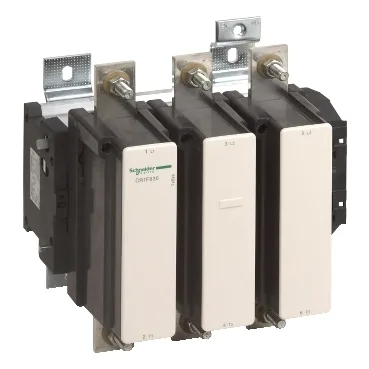
This makes it a fit for applications where sustained coil draw is undesirable, such as battery-backed or UPS-fed control circuits, or where heat dissipation in the panel is a concern. It is a 3-pole, normally-open device rated for control applications. That 630 A AC-4 rating means it handles the high-stress switching of motor reversal and jogging without accelerated contact wear. Motor power capability spans the voltage range: 450 kW at 690 V AC, 400 kW at 440 V, 375 kW at 415 V, 335 kW at 400 V, and 200 kW at 230 V. For UL/CSA installations, horsepower ratings are 800 hp at 575-600 V, 600 hp at 460-480 V, 300 hp at 220-240 V, and 250 hp at 200-208 V, all for 3-phase motors. This gives a clear selection path regardless of the regional standard.
Rated insulation voltage is 1000 V per IEC 60947-4 and BS 775, with an impulse withstand voltage of 8 kV. That 1000 V Ui means the contactor is designed for 690 V line-to-line systems with margin, and the 8 kV impulse rating ensures it survives transient overvoltages common in industrial distribution without flashover. Short-time withstand current (Icw) is 5050 A for 1 second at 40 °C, tapering to 1600 A for 10 minutes. This defines how long the contactor can carry fault current while upstream protection clears — critical for selectivity coordination with fuses or breakers. The associated fuse rating is 630 A aM or gG, which sets the maximum overcurrent protection the contactor is tested with. Rated breaking capacity reaches 6300 A at 220-440 V, dropping to 3200 A at 1000 V. Control circuit is 127 V DC low-consumption type. Latching and unlatching both operate reliably between 85% and 110% of Uc. Average consumption is 620 W during the latching pulse and 45 W during unlatching — but remember, this is pulse power only; steady-state coil draw is zero once latched. Operating time is 40-80 ms to latch, 50-100 ms to unlatch.
This is a panel-mount contactor, not DIN-rail — the TeSys F frame size is bolted directly to a backplate or mounting chassis. Dimensions are substantial: 12.2 in (309 mm) wide, 12.0 in (304 mm) high, 10.04 in (255 mm) deep. Terminal connections are via bars sized 60 x 5 mm, torqued to 513.3 lbf·in (58 N·m). The protective treatment is TH (tropicalized) for humid environments. Utilisation categories cover AC-1 (resistive), AC-3 (motor start/run), and AC-4 (plugging/inching) — so it is suited for both straightforward motor starting and the most severe reversing duty.