The same contactor also carries an AC-1 rating for resistive circuits like heating elements or lighting, where the switching stress is lower.
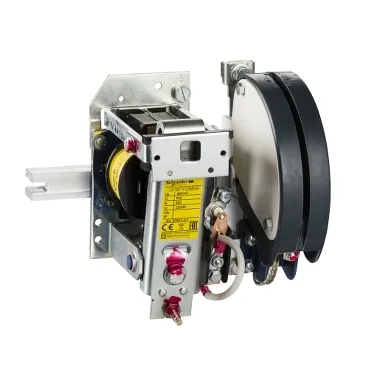
The control circuit operates on 220 V DC, which is a specific coil voltage — not the common 24 V DC or 110 V AC found on many panel designs. If your control voltage is 220 V DC, this part is a direct fit; if not, you will need a different coil variant within the CV1BF family. The DC coil means the contactor holds in without the hum of an AC coil, and it drops out cleanly when the DC supply is removed, which can simplify suppression in some circuits.
Termination and auxiliary contacts
Power circuit connections are bolted — expect to land ring or fork terminals on the main lugs, not spring-cage or screw-clamp terminals. The auxiliary contact block is built in with 1 normally-open and 1 normally-closed contact, enough for a basic seal-in or status feedback circuit without adding a separate aux block. For more aux contacts, an add-on block from the TeSys B family would be needed.