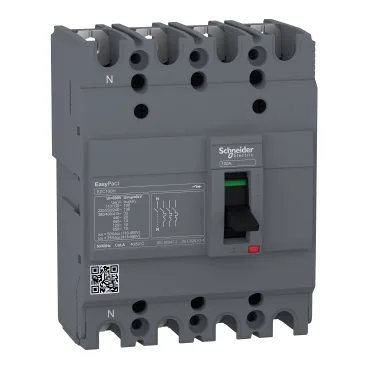
The front-front connection (line and load both from the front) keeps wiring straightforward in a standard backplate layout.
Breaking capacity — what those numbers mean
The Icu (ultimate breaking capacity) varies by voltage, and the right column for your panel voltage is what governs the installation. At 380…400 V AC the breaker interrupts 30 kA; at 220…240 V AC it handles 50 kA. On DC circuits it's rated 10 kA at 125 V DC (single-pole) or 250 V DC (two-pole in series). If your system's prospective short-circuit current exceeds these numbers, you need a larger-frame breaker upstream.
Mounts fixed to a backplate — no DIN-rail clip, so plan for screw-down or bolted mounting. Dimensions are 100 mm wide, 130 mm high, 60 mm deep, with a 25 mm connection pitch between poles. The IP20 finger-safe enclosure is fine for a closed panel; IK07 impact rating means it survives the odd dropped tool during commissioning. If your environment is cleaner (PD2), you still meet the requirement easily.
Designed and tested to JIS C8201-2-2, EN/IEC 60947-1, EN/IEC 60947-2, and GB/T 14048.2. It carries a 'suitability for isolation' marking per IEC 60947-2, so you can use it as a visible-break disconnect — the positive contact indication (toggle position shows contact state) confirms the circuit is open. No integral earth-leakage protection; if you need that, add an external RCD or specify the EZC100H with a Vigi module.