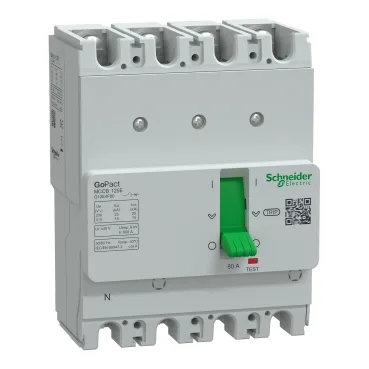
80 A 4-pole distribution breaker, current lifecycle
The G12E4F80 is a Schneider Electric GoPact MCCB 125 — a 4-pole molded case circuit breaker with a TM-D thermal-magnetic trip unit, rated 80 A at 40 °C. The LI protection curve (thermal for overload, magnetic for short-circuit) is the standard fixed-trip pattern — no interchangeable rating plugs, no electronic adjustments. Current lifecycle stage per the manufacturer, so it is a standard catalogue item, not a phase-out or NRND part.
Mounting and connections — backplate, front terminals, 25 mm pitch
Mounts fixed to a backplate — no DIN-rail adapter here. Both line and load connections are front-facing screw terminals, which keeps wiring accessible in a row of breakers but means you plan the busbar run to land on the front, not the rear. The breaker can be mounted horizontally or vertically flat on the backplate, which helps when you are squeezing it into a shallow enclosure. IP20 finger-safe protection on the front face; the terminals themselves are live when the breaker is on, so panel builders typically add a terminal shield or warning label.
Standards and isolation — EN/IEC 60947-2, suitability for isolation, pollution degree 3
Rated and certified to EN/IEC 60947-2, including Annex H for EMC immunity in the industrial environment. Overvoltage category III puts it on the fixed-installation side of the meter, not downstream of a sub-distribution board. The 440 V rated insulation voltage and 415 V operational voltage at 50/60 Hz are the electrical boundaries to check against your system voltage — if you are on a 480 V delta system, the insulation voltage is marginal; verify coordination with the 440 V Ui limit.
Durability and thermal budget — 8000 electrical cycles, 18.7 W per pole
Rated for 8000 electrical cycles at rated current and 415 V, and 30000 mechanical cycles. That electrical endurance is typical for a distribution breaker — enough for years of infrequent switching, but not for daily load-break duty. The 18.7 W power dissipation per pole adds up to about 75 W total at full load, which you need to vent out of a sealed enclosure; a small cabinet with several breakers side by side can heat up noticeably. The altitude rating is 0-2000 m without derating, and 2000-5000 m with derating — above 2000 m the air density drops and the arc-quenching performance changes, so the manufacturer expects you to reduce the current rating.