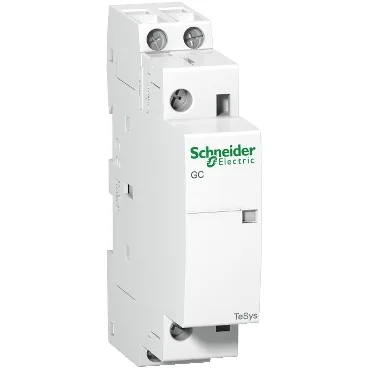
The GC2511F5 is a 2-pole modular contactor from the TeSys GC range, designed for switching lighting, motor, and heating loads. It uses a 110 V AC 50 Hz control circuit and carries AC-7A and AC-7B utilisation categories — so it's rated for resistive loads like heating elements (AC-7A) and moderate inductive loads like small motors (AC-7B). Let me show you why that matters for your panel: AC-7B specifically covers the higher inrush of motor starts, meaning this contactor can handle the locked-rotor current of fractional-horsepower motors without welding its contacts. The depth is 62.5 mm and height 81 mm — compact enough for shallow gland plates. Control and power connections are screw clamp terminals; torque both to 0.8 N·m. For the power circuit, it accepts up to 6 mm² flexible wire, which is plenty for the 25 A continuous rating.
For normal switching, the associated fuse rating is 25 A gL at ≤ 440 V for the power circuit, so size your upstream fuse accordingly. Electrical durability is 100,000 cycles for both AC-7A and AC-7B duty. Mechanical durability is 1,000,000 cycles. That means the contacts will last through 100,000 load-switching operations before you need to think about replacement — good for a machine that cycles a few times per minute over a few years. Maximum operating rate is 300 cycles per hour at 50 °C, so don't push it faster than one cycle every 12 seconds in continuous use. Heat dissipation is 1.3 W at 50/60 Hz, with 1.6 W per pole. That's low enough that you don't need to worry about thermal buildup in a standard IP40 enclosure, but if you're packing a dozen of these side by side, account for the total heat in your panel cooling calculation.
Where to use it — and where not to
This contactor is intended for lighting control, motor control (small motors), and heating applications. The AC-7A category covers resistive loads like incandescent lamps or electric heaters. AC-7B covers inductive loads like small single-phase motors, pumps, and fans — the kind you'd find in HVAC or light industrial equipment. It's not rated for heavy three-phase motor starting (that's AC-3 territory), so don't spec it for a 5 HP compressor. The control circuit is 110 V AC 50 Hz only. The coil operates between 0.85 and 1.1 times Uc and drops out between 0.2 and 0.75 Uc. Operating altitude is up to 3000 m. IP20 protection (fingers) on the contactor itself, IP40 when installed in an enclosure per VDE 0106. That means it's not suitable for washdown or dusty environments without a proper cabinet. The protective treatment is 'TC' — standard tropicalisation for humidity resistance, but not a sealed coating.
It's part of the broader TeSys GC family, which shares the same footprint and terminal layout across similar ratings. If you're standardising on a single contactor for multiple load sizes, the GC25 frame (this one) is the 25 A variant — there are smaller and larger versions in the same 17.5 mm-wide package. No direct pin-compatible replacement exists within the family because the GC25 is the current design; a future successor would be announced via a product change notice (PCN).