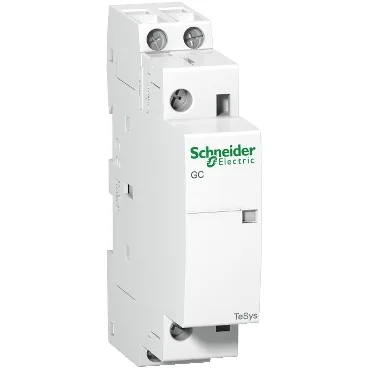
It is rated for AC-7A and AC-7B utilisation categories, which means it handles the inrush and running currents of small motors and lighting ballasts, not just resistive loads. The control circuit is 220-240 V AC at 60 Hz, a common voltage for North American panel builds.
At 17.5 mm wide (one 18 mm module), this contactor packs into tight DIN-rail layouts where every slot counts. For continuous duty, the average impedance of 2.5 mOhm on the power circuit keeps heat dissipation at 1.3 W (at 50/60 Hz), or 1.6 W per pole, which is low enough to avoid derating in a crowded enclosure. Mechanical durability is rated at 1,000,000 cycles, with electrical durability at 100,000 cycles for both AC-7A and AC-7B duty — a solid service life for a modular contactor.
Clip-on mounting to standard DIN rail, 35 mm per EN 60715. The 17.5 mm width means it occupies one 18 mm module position — essential for panel fill-factor planning. Screw-clamp terminals on both control and power circuits: power accepts up to 6 mm² flexible or solid, control up to 2.5 mm². Tightening torque is 0.8 N.m for both circuits. IP20 protection (fingers) out of the enclosure, IP40 when installed in a cabinet. Operating altitude up to 3000 m, and the contactor can be mounted at up to 30° from vertical.
Designed and tested to IEC 60947-5 (control circuit devices) and IEC 61095 (electromechanical contactors for household and similar purposes). These standards cover the rated making and breaking capacities, insulation coordination (rated insulation voltage 500 V), and thermal performance. The IP ratings (IP20 bare, IP40 in enclosure) conform to VDE 0106 for protection against direct contact.