What the ratings mean for your panel
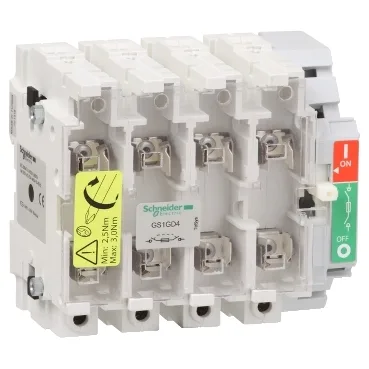
The GS1GD4 is a 4-pole switch-disconnector-fuse from the TeSys GS range, designed for isolation and switching of motor and resistive loads under load. The 63 A rated operational current at 400 V in AC-23B duty means it handles frequent switching of motor loads up to that current — AC-23B is the category for occasional switching of motors or other highly inductive loads. The 500 A breaking capacity at 400 V AC-23B and 630 A making capacity tell you it can close onto and interrupt fault currents within its rating, not just isolate a dead circuit. The 4-pole configuration with 4 NO contacts gives you full isolation on all phases plus the neutral in a single unit — common for three-phase plus neutral disconnection in distribution panels. The direct right-side operating handle provides a clear visual indication of contact position, required for lockout/tagout compliance.
Duty ratings and application context
Rated operational power spans 33 kW at 400 V, 45 kW at 500 V, and 55 kW at 690 V — these are the motor sizes this switch can handle at each voltage level. The conventional free air thermal current Ith is 63 A at 40 °C, which is the continuous current rating in open air; in an enclosed panel you may need to derate depending on ambient and adjacent devices. Electrical durability is rated at 1500 cycles for AC-23A and AC-23B, and 300 cycles for DC-23A and DC-23B. Mechanical durability is 10,000 cycles. For a switch-disconnector used primarily for infrequent isolation (a few times per shift), these cycle counts are adequate; for a switching application approaching the rated frequency, factor the electrical endurance into your maintenance schedule. Short-circuit withstand is 10.6 kA, and with gG fuse backup the rated short-circuit making capacity Icm reaches 100 kA at 400 V. This means the switch can withstand a fault up to 10.6 kA without welding or bursting, and with the correct upstream fuses it can make onto a 100 kA prospective fault — the fuses clear the fault while the switch survives.
Compliance, environment, and mounting
Designed to IEC 60947-3, the standard for switches, disconnectors, switch-disconnectors and fuse-combination units. Rated insulation voltage Ui is 750 V AC, and impulse withstand voltage Uimp is 8 kV — sufficient for 400 V and 690 V systems with appropriate overvoltage category. IP20 protection with terminal cover means finger-safe from the front but not protected against water ingress — suitable for indoor panel mounting, not washdown environments. Fire resistance testing at 850 °C for the fuse cover and 960 °C for the body per IEC 60695-2-1 confirms the thermoplastic will not propagate flame under fault conditions. Mounting is plate-mount — not DIN rail — so plan for screw-fixing to a backplate or mounting panel. Dimensions are 6.5 in (165 mm) wide, 4.6 in (118 mm) height, and 4.6 in (116.5 mm) depth. Power circuit connections accept lugs or ring terminals for 10 to 25 mm² flexible cable, torqued to 3.2 N·m. Accepts DIN-type fuse links, size 000. Operating temperature range is -20 to 70 °C, storage -40 to 80 °C. Protective treatment TH indicates tropicalized protection against heat and humidity.
Sourcing and lifecycle
Sourced through authorized distribution channels. The landed cost depends on your Incoterm preference; think landed, not list when budgeting.