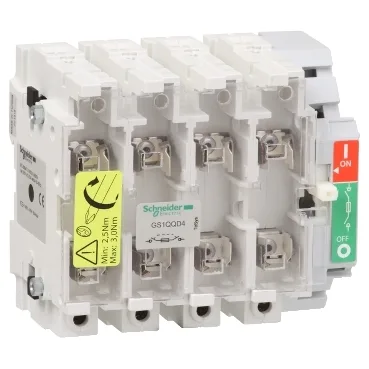
The Schneider GS1QQD4 is a TeSys GS switch-disconnector-fuse, a 4-pole device with 4 NO contacts rated for 400 A conventional free-air thermal current (Ith) at 40 °C. It's built to IEC 60947-3, the standard for disconnectors and switch-disconnectors, meaning it provides visible isolation and can break load current under fault conditions. The key operational current ratings vary by duty and voltage: it handles 400 A at 400 V in AC-23B (motor switching with occasional inrush), 315 A at 690 V AC-23B, and 315 A at 500 V AC-23B. For DC applications, it's rated 200 A at 440 V DC-23B with poles not juxtaposed, and 315 A at 440 V DC-23A with poles not juxtaposed. Breaking capacity is 3200 A at 400 V (AC-23B), and making capacity is 4000 A at 400 V AC-23B. With proper gG fuse protection, the rated short-circuit making capacity (Icm) reaches 100 kA at 400 V. The short-circuit withstand rating is 40 kA overall.
Where it's deployed
This is a panel-mounted switch-disconnector-fuse, sized for plate mounting. It accepts power-circuit connections via lugs-ring terminals for 185 to 240 mm² flexible cable, torqued to 25 N·m. The 4-pole, 4 NO arrangement with a direct right-side operating handle makes it a straightforward main disconnect or feeder switch in an industrial control panel. The TH protective treatment indicates it's suitable for tropical/humid environments, but the enclosure itself must provide the environmental seal.
For motor loads, the AC-23B rating (315 A at 690 V) governs. The 33 W breaking capacity and 3200 A breaking capacity at 400 V indicate fault interruption capability. Rated operational power reaches 220 kW at 400 V, 220 kW at 500 V, and 295 kW at 690 V, giving you a direct motor-sizing reference. Mechanical durability is rated at 10,000 cycles, and electrical durability at 1,000 cycles for AC-23A and AC-23B, and 200 cycles for DC-23A and DC-23B. This isn't a daily-switching device — it's a disconnect for infrequent operation, typically a few times per shift or for maintenance isolation.