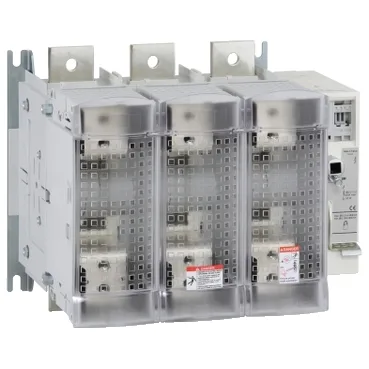
The GS2TB3 is a TeSys GS switch-disconnector-fuse rated for 800 A at 400 V AC-23B, which is the category for motor switching with occasional overload — the most common duty for a disconnect on a large motor feeder or distribution branch. Rated operational power is 450 kW at 400 V and 400 kW at 690 V, so this is sized for large motors or heavy feeder loads. The 3-pole configuration with 3 NO contacts and a BS fuse type in size C3 is a standard UK-market specification — the fuse carrier accepts BS 88 fuses, which have different dimensions and breaking characteristics than continental NH or DIN types. If your BOM calls for BS fuses, this is the right holder; swapping to a different fuse standard means changing the entire switch. The switch-disconnector-fuse is a single device that combines a visible-break isolating switch with fuse protection — it provides both isolation for safe maintenance and overcurrent protection in one package. It is used in motor control centers, distribution boards, and as a main disconnect for machinery where fuse protection is preferred over a circuit breaker for its higher interrupting capacity and current-limiting action.
Mounts on a plate (not DIN rail) — the 364 mm width, 300 mm height, and 250 mm depth mean it needs a backplate cutout and four fixing points, not a snap-on rail. Power circuit terminals accept bars up to 63 mm² or ring lugs for two cables of 300 mm² or two of 185 mm². Tightening torque is 44 N·m, which requires a torque wrench — not a screwdriver. The external frontal, direct frontal, or external right-side operating handle options give flexibility for enclosure layout. The 850 °C fuse cover and 960 °C body fire resistance (IEC 60695-2-1) means it passes the glow-wire test for unattended equipment, which is relevant for CE marking and machinery directive compliance.