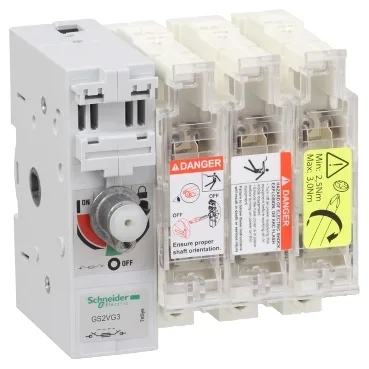
It takes DIN-type fuses, size 4, and is built to IEC 60947-3 for isolation and switching duty. Its headline operational current hits 630 A at 690 V in AC-23B (motor switching), and 1000 A at 440 V in the same category — that's the rating that decides fit for a motor feeder or distribution branch. The making capacity is 10 kA at 400 V AC-23B, and the breaking capacity is 8 kA at 400 V in that same duty. Rated operational power reaches 560 kW at 400 V, 560 kW at 500 V, and 475 kW at 690 V. Short-circuit withstand is 90 kA, with an impulse withstand voltage of 12 kV.
This is a plate-mounted unit — not DIN-rail snap-on. It measures 442 mm wide by 355 mm high by 289 mm deep, so plan the enclosure backplate real estate accordingly. The external left-side operating handle means the door cutout and interlock placement need to account for that swing. Power circuit terminals accept bars up to 80 mm² or lugs/ring terminals for up to four 185 mm² cables. Tightening torque is a substantial 44 N·m on the power side — that's a big wrench, not a screwdriver. IP20 with the terminal cover fitted, so it's panel-internal only; no washdown exposure.
The GS2VG3 carries a fire resistance rating: 850 °C on the fuse cover and 960 °C on the body, per IEC 60695-2-1. That matters for compliance dossiers in machinery CE marking or panel-build standards. Electrical durability is 500 cycles in AC-23A/B, 100 cycles in DC-23A/B; mechanical durability is 5000 cycles.