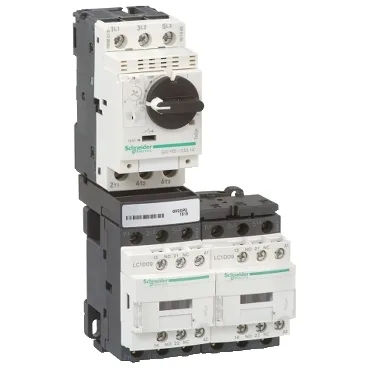
The Schneider TeSys GV2DP216BL is a reversing motor starter combination — a single assembly that handles forward/reverse control of a three-phase motor up to 9 kW at 500 V AC. It bundles a 3-pole reversing contactor, a GV2AF3 combination block, and a GV2P motor circuit breaker into one unit, so you get short-circuit protection, overload protection, and reversing switching in one panel footprint. Rated AC-3 for motor starting duty, with a thermal protection adjustment range of 9...14 A. That 9-14 A window covers a 5.5 kW motor at 400/415 V, and the magnetic trip is fixed at 170 A — enough to handle inrush without nuisance tripping on a DOL start. The control circuit runs on 24 V DC, which is standard for PLC-driven panels and keeps the coil safe for low-voltage control architectures.
Coordination and breaking capacity
Type 2 coordination means that under a short-circuit fault, the starter remains usable — no welding of contacts, no replacement of the contactor after a fault. This is the spec that matters for production lines where downtime for contactor swap is not acceptable. Rated breaking capacity hits 130 kA at 400/415 V (IEC 60947-4-1), which is high for a compact reversing starter. At 440 V it still manages 50 kA, and at 500 V it holds 42 kA.
For BOM planning, this is a fast mover in the TeSys family. Keep it on the shelf if you have multiple 5.5 kW reversing drives in the plant — the 9-14 A thermal range is a common sweet spot for 4-pole motors at 400 V.
The assembly measures 90 mm wide, 186.8 mm high, and 111.9 mm deep. That 90 mm width is three standard 30 mm module slots on a DIN rail — typical for a reversing starter with integrated breaker. Depth of 111.9 mm means it clears most 120 mm deep enclosures, but check gland plate clearance if you are back-mounting.