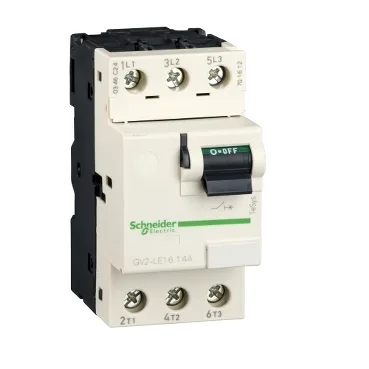
At 400/415 V AC the breaking capacity drops to 15 kA, still enough for most industrial distribution boards. Rated for motor duty in utilisation category AC-3 (switching squirrel-cage motors during running), it handles 5.5 kW at 400/415 V AC and up to 11 kW at 690 V AC. The electrical durability is rated at 100,000 cycles under AC-3 at 415 V — that's the number of on-load operations you can expect before contact wear reaches end-of-life.
The 45 mm width means it takes up one standard modular space in a DIN-rail enclosure — plan your fill factor accordingly. Screw-clamp terminals accept up to 6 mm² solid or 4 mm² flexible with ferrule; torque to 1.7 N·m. IP20 finger-safe terminals are standard for enclosed panels. Ambient storage range is -40 to 80 °C, which covers most unheated warehouses.
Approvals include EN/IEC 60947-2 (circuit-breaker standard), EN/IEC 60947-4-1 (contactor/motor-starter standard), UL 60947-4-1, and CSA C22.2 No 60947-4-1. Also listed for IEC/EN 60335-2-40 Annex JJ (heat-pump and air-conditioning safety). These cover most industrial and commercial installations in North America and Europe.
Breaking capacity (Icu) per IEC 60947-2: 100 kA at 230/240 V AC, 15 kA at 400/415 V AC, 8 kA at 440 V, 6 kA at 500 V, 3 kA at 690 V. The 15 kA at 400 V is the more common coordination target for European 400 V distribution. Rated insulation voltage (Ui) and operational voltage (Ue) both 690 V AC. Power dissipation is 1.8 W per pole — 5.4 W total at full load, which matters for thermal management in a sealed enclosure. Mechanical durability is 100,000 cycles; the toggle control is manual-reset only.