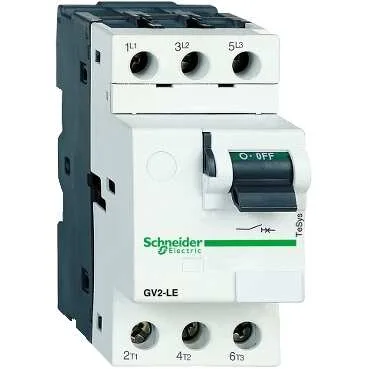
It's a 3-pole device with a rated current of 25 A and magnetic trip technology, meaning it uses a fixed magnetic trip coil for short-circuit protection rather than a thermal bimetallic strip. This breaker is rated for motor protection duty in utilisation category AC-3 (and AC-3e) per IEC 60947-4-1, which covers starting and disconnecting squirrel-cage motors during running. The motor power ratings span 9 kW at 400/415 V up to 18.5 kW at 690 V, so it covers a useful range of small to medium induction motors on 400 V and 690 V line supplies.
The breaking capacity (Icu) varies significantly with voltage: 50 kA at 230/240 V, 15 kA at 400/415 V, 6 kA at 440 V, 4 kA at 500 V, and 3 kA at 690 V. At the common 400 V industrial supply, 15 kA is adequate for most downstream distribution panels but may need upstream current-limiting fuses or a higher-rated breaker if the prospective fault current exceeds that level. For selective coordination, you'd need a Category B breaker. This is a standard distinction for motor circuit breakers — they clear fast, which is what motor protection needs, but it means the upstream breaker must be sized to handle the full fault current.
The 45 mm width (3 module spaces) fits standard enclosure rail. Horizontal or vertical orientation is acceptable, which helps when laying out a dense panel. Power connections use screw clamp terminals accepting 1 to 6 mm² solid or 1.5 to 6 mm² flexible cable (without ferrule), or 1 to 4 mm² with ferrule. Tightening torque is 1.7 N·m.
As a current-production part, lead times are standard for the TeSys Deca family. If you need a set of 24 (the quantity per set), that's the standard packaging unit — order one line item.
Certified to EN/IEC 60947-2 (circuit-breakers), EN/IEC 60947-4-1 (contactors and motor-starters), UL 60947-4-1, CSA C22.2 No 60947-4-1, and IEC/EN 60335-2-40 Annex JJ (for heat pump applications). The UL and CSA marks cover North American installations. It's also suitable for isolation per IEC 60947-1, meaning it can be used as a visible-break disconnect when locked off. Climatic withstand conforms to IACS (marine/offshore environmental testing). Fire resistance is 960 °C per IEC 60695-2-11. Operating altitude is limited to 2000 m without derating.