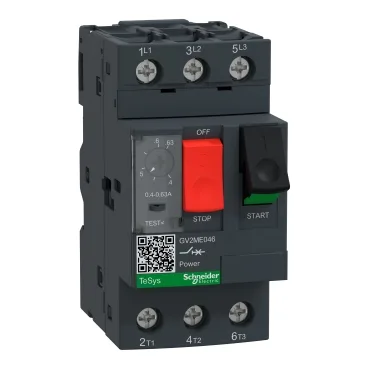
The 0.63 A rated current (In) sets the continuous load it'll carry without tripping — match this to the motor's full-load amps. The magnetic trip kicks in at 9.3 A, so it clears a locked-rotor or short-circuit fault fast without nuisance-tripping on startup inrush. Motor power ratings are 0.12 kW at 400/415 V and 0.37 kW at 690 V — so on a 400 V line, this breaker covers a small fractional-horsepower motor (think a little fan or a coolant pump). The thermal-magnetic trip gives phase-failure sensitivity per IEC 60947-4-1, meaning it'll drop out if one phase drops, protecting the motor from single-phasing. Power dissipation is 2.5 W per pole. Factor that into your thermal budget when packing several in a panel.
Dimensions are 89 mm high, 45 mm wide, 78.5 mm deep, so it fits in a standard 45 mm-wide slot. Mount it horizontally or vertically; the specs allow both. The screw-clamp terminals accept up to 6 mm² solid or 4 mm² flexible with ferrules, and the tightening torque is 1.7 N·m — a standard screwdriver setting, nothing special. IP20 protection means it's safe from finger contact but not sealed against moisture or dust — this is a panel-mount part, not a field-mount one. Rated for 2000 m altitude and 30 Gn shock / 5 Gn vibration, so it'll hold up on a machine skid or in a vibrating pump panel.
Standards and approvals — what the certs mean
This breaker carries approvals under IEC/EN 60947-2 (circuit-breaker standard) and IEC/EN 60947-4-1 (contactor/motor-starter standard), plus UL 60947-4-1 and CSA C22.2 No 60947-4-1. That means it's accepted for use in North American and European installations — no extra fuse or coordination study needed for the motor branch circuit.