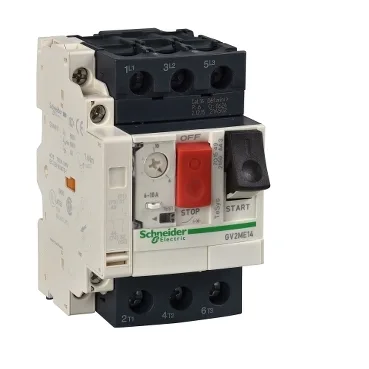
It's a 3-pole, thermal-magnetic device rated at 1 A (In), with a breaking capacity of 100 kA Icu at 400/415 V AC — that means it can safely interrupt a fault current up to 100 kA without welding its contacts or cascading the fault upstream, which is critical for panel SCCR compliance. Motor power ratings are 0.25 kW at 400/415 V AC and 0.37 kW at 500 V AC — so it's sized for small fractional-horsepower motors, typical on pumps, fans, or conveyors in light industrial lines. The 1 A rated current also means it can protect a motor drawing up to 1 A full-load, with the thermal adjustment band set accordingly. It includes phase-failure sensitivity per IEC 60947-4-1, which will trip if one phase drops out, preventing single-phasing damage to the motor. The 45 mm width (3-module footprint) is standard for a 3-pole breaker, so it fits neatly into a DIN-rail enclosure without crowding adjacent devices. IP20 finger-safe terminals, IK04 impact resistance — fine for inside a locked panel, not for washdown zones.
It carries approvals under EN/IEC 60947-2, EN/IEC 60947-4-1, UL 60947-4-1, and CSA C22.2 No 60947-4-1, plus IEC/EN 60335 appliance-safety standards. That covers most industrial and commercial installations in North America and Europe. The side-mount format means it doesn't increase the breaker's width, keeping the DIN-rail fill factor tight.
Most breakers in this class derate their breaking capacity at higher voltages; this one holds 100 kA all the way to 690 V. The magnetic trip threshold is 15.1 A, which is about 15x In — typical for motor-starting inrush, which can hit 6-8x FLA. That ratio means it won't nuisance-trip on a healthy motor start but will clear a bolted fault fast. The thermal element follows an inverse-time curve for overload protection, coordinated with the motor's thermal damage curve. Power dissipation is 2.5 W per pole, so 7.5 W total for the 3-pole device at rated current. In a densely packed panel, that's worth noting for thermal management — it's low enough not to require forced cooling in most enclosures, but if you're stacking multiple breakers in a small box, derate ambient temperature accordingly.
Installation and integration notes
Terminals accept 1 to 6 mm² solid or 1.5 to 6 mm² flexible (without ferrule), or 1 to 4 mm² flexible with ferrule — two cables per terminal. Tightening torque is 1.7 N·m on the screw clamp. That's standard for this current class; use a torque screwdriver to avoid terminal damage or poor contact. Strip length for flexible cable with ferrule is about 8 mm. Mounting position can be horizontal or vertical — no derating required for orientation. The dark grey colour is the TeSys Deca standard, matching other GV2ME and GV2P breakers in the line for a uniform panel appearance. Mechanical durability is 100,000 cycles; electrical durability is also 100,000 cycles for AC-3 at 415 V. That's a high endurance rating for a motor starter combination — it's designed for frequent switching applications like conveyor cycling or pump start/stop. The 30 Gn shock and 5 Gn vibration rating covers most industrial environments, including near heavy machinery.