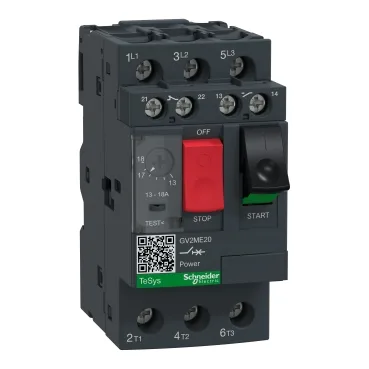
That 100 kA breaking capacity at 230/240 V means it can interrupt a fault at that level without upstream damage; at 400/415 V it's still 15 kA, which covers most panel-fed motor circuits. It's sized for a 7.5 kW motor on a 400/415 V supply, or up to 15 kW at 690 V. The 18 A setting puts it in the middle of the GV2ME range — common for small conveyors, pumps, and fans in a control panel.
Clips onto 35 mm symmetrical DIN rail, or screws to a panel with an adapter plate. The 45 mm width takes one standard modular slot — that's another SKU I don't need to worry about for panel layout. Mounts horizontal or vertical. IP20 when open-mounted, so it lives inside an enclosure, not on the line side of the cabinet. Power terminals are screw clamp, accepting up to 2 x 6 mm² solid or 2 x 4 mm² flexible with ferrule. Tighten to 1.7 N·m.
Listed to EN/IEC 60947-2 (circuit-breaker standard) and EN/IEC 60947-4-1 (contactor/motor-starter standard), plus UL 60947-4-1 and CSA C22.2 No 60947-4-1. Also carries IEC/EN 60335-2-40 and 60335-1 Clause 30.2 for appliance applications. The fire-resistance rating is 960 °C per IEC 60695-2-11. Climatic withstand per IACS. Suitable for isolation per IEC 60947-1. Lifecycle status is current — this is an active catalog line, not a phase-out or NRND part. No official successor listed because none is needed. It's a standard TeSys Deca item, widely stocked and cross-referenced.
Durability and environment
Rated for 100,000 electrical cycles at AC-3 (415 V at full load current) and the same for AC-3e. Mechanical durability matches at 100,000 cycles. Handles 30 Gn shocks for 11 ms and 5 Gn vibration from 5 to 150 Hz. Power dissipation is 2.5 W per pole — negligible for panel heat budget.