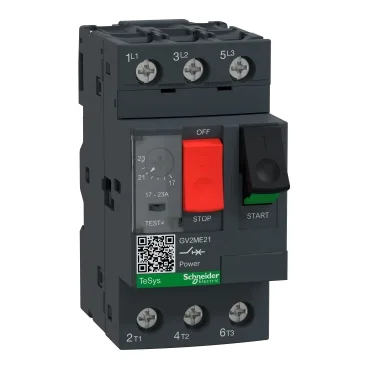
It's a 3-pole device, so it handles three-phase motor loads up to 9 kW at 400 V, 11 kW at 500 V, or 18.5 kW at 690 V — pick the rating that matches your line voltage. The magnetic trip fires at 341 A, which clears a bolted fault fast enough to protect downstream contactors and cable. Phase-failure sensitivity is built in per IEC 60947-4-1, so if one phase drops on a three-phase motor, the breaker trips before single-phasing cooks the winding. That's a standard feature on this class, but worth confirming if you're swapping in a non-Schneider spare.
The GV2ME21AP carries a 50 kA Icu at 230/240 V AC, dropping to 15 kA at 400 V, 6 kA at 440 V, 4 kA at 500 V, and 3 kA at 690 V. For a 400 V panel fed from a transformer under 1000 kVA, 15 kA is usually enough headroom — but if your SCCR study calls for 25 kA at that voltage, you'll need a current-limiting upstream breaker or a higher-rated GV2 frame.
If you're panel-mounting, you'll need the separate adaptor plate. The screw-clamp terminals accept up to 6 mm² solid or 4 mm² flexible with ferrule, two cables per clamp. Tightening torque is 1.7 N·m, which is standard for this terminal size; a torque screwdriver is worth the time on a production line. Dimensions are 89 mm high, 45 mm wide, 78.5 mm deep — that's a compact footprint for a 23 A motor circuit breaker. The IP20 finger-safe enclosure means it's fine inside a panel but not for wet or dusty locations without an outer enclosure.
Listed to EN/IEC 60947-2 (circuit-breaker standard) and EN/IEC 60947-4-1 (contactor/motor-starter standard), plus UL 60947-4-1 and CSA C22.2 No 60947-4-1. That covers most industrial panels in North America and Europe.