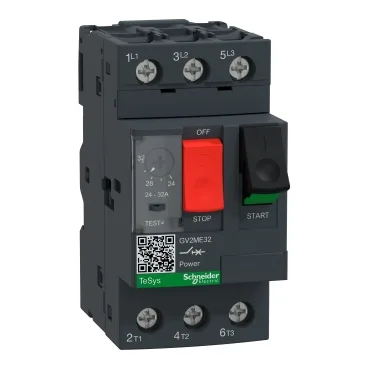
Rated 32 A continuous, it handles motor loads up to 15 kW at 400/415 V AC, 18.5 kW at 500 V, and 22 kW at 690 V. The thermal-magnetic trip unit provides overload protection via the thermal element and short-circuit protection via the magnetic element, which trips instantaneously at 537.6 A. Breaking capacity is 50 kA at 230/240 V, dropping to 10 kA at 400/415 V, 6 kA at 440 V, 4 kA at 500 V, and 3 kA at 690 V — these are the Icu values per IEC 60947-2.
Dimensions are 89 mm high, 45 mm wide, 78.5 mm deep — a standard 45 mm module width that lines up with other TeSys Deca components in a motor control centre or distribution board. Power connections are screw-clamp terminals accepting 1 to 6 mm² solid or 1.5 to 6 mm² flexible (without ferrule), or 1 to 4 mm² flexible with ferrule. Tightening torque is 1.7 N·m. The IP20 finger-safe enclosure (IK04 impact resistance) suits panel-mount applications where the breaker is behind a cabinet door.
Compliance documentation is solid: the breaker carries UL 60947-4-1, CSA C22.2 No 60947-4-1, and EN/IEC 60947-2 and 60947-4-1 approvals. Phase-failure sensitivity is built in per IEC 60947-4-1, so it will trip on a lost phase — a common failure mode in motor circuits.
Electrical durability is rated at 100,000 cycles for AC-3 and AC-3e duty at 415 V at full rated current — that is the switching life under motor starting conditions. Mechanical durability is also 100,000 cycles. Power dissipation per pole is 2.5 W, so total heat load at full load is 7.5 W — factor that into your enclosure thermal budget. The utilisation category is AC-3 (squirrel-cage motor starting) and AC-3e (enhanced motor starting) per IEC 60947-4-1, plus Category A for distribution per IEC 60947-2. The suitability-for-isolation mark (per IEC 60947-1) means it can serve as a visible disconnection point in the motor circuit. Operating altitude is limited to 2000 m without derating. The breaker is rated for uninterrupted duty, so it can carry rated current continuously in a motor branch.