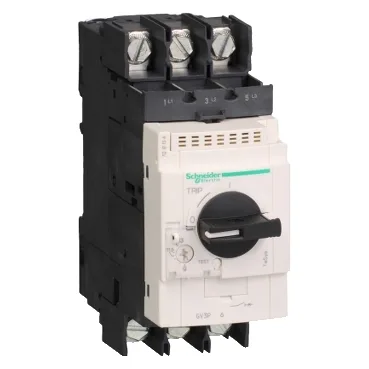
The headline number for this part is the breaking capacity: 100 kA Icu at 400/415 V AC, which means it can safely interrupt a fault current up to 100,000 amps at that voltage without welding its contacts or rupturing the enclosure. That's a high-interrupting rating for a 13 A breaker — it lets you place this close to a large transformer or a high-capacity bus without needing upstream fuses to back it up. For motor duty, the GV3P136 is rated AC-3 per IEC 60947-4-1, which covers starting and stopping squirrel-cage motors. At 400/415 V it handles 5.5 kW; at 500 V it handles 7.5 kW; at 690 V it handles 11 kW. The magnetic trip is set at 182 A, which is 14x In — that's a standard motor-starting multiple that avoids nuisance trips on inrush while still clearing a locked-rotor fault.
The connection pitch is 17.5 mm without spreaders, which is the standard TeSys Deca spacing — it lines up with the busbars and the downstream contactor in a motor starter assembly. It's rated IP20 on the enclosure (finger-safe) and IK09 for impact resistance, so it handles the bumps of a live panel. The operating altitude goes to 3000 m without derating, which covers most installations outside high-mountain sites. Ambient storage range is -40 to 80 °C. Phase failure sensitivity is built in — if one phase drops, the breaker trips on the unbalance, which is critical for preventing single-phasing damage on a motor.
Approvals cover the major industrial jurisdictions: UL 60947-4-1, CSA C22.2 No 60947-4-1, and EN/IEC 60947-2 and -4-1. The fire-resistance rating is 960 °C per IEC 60695-2-11, which satisfies the glow-wire test for unattended equipment. Climatic withstand conforms to IACS for marine environments.