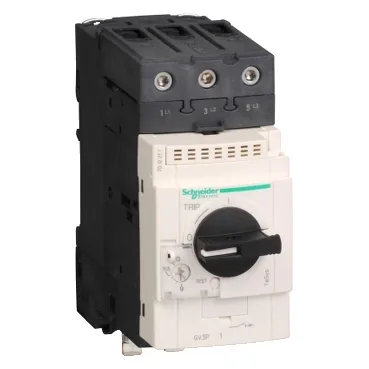
What the 25 A rating and 100 kA breaking capacity mean for your panel
The GV3P251 is a motor circuit breaker from the TeSys Deca range, rated 25 A continuous with a thermal adjustment band of 17 to 25 A. The magnetic trip is fixed at 350 A, which clears a bolted fault fast without nuisance tripping on startup inrush. In a panel with a transformer feeding a high-fault bus, this lets you avoid an upstream current-limiting fuse for most installations. For motor starting duty it's rated AC-3 per IEC 60947-4-1, which covers starting and disconnecting squirrel-cage motors under load. The uninterrupted duty rating means it can carry rated current continuously without derating in a 40 °C ambient.
Mounting, isolation, and what the IP20 and IK09 ratings tell you
Mounts on 35 mm symmetrical DIN rail — clips on without tools, or you can screw it to a backplate with three M4 screws if vibration is a concern. The dimensions are 132 mm high by 55 mm wide by 136 mm deep, so it takes up about the same footprint as a standard three-pole contactor in the TeSys range. Mounting position is horizontal or vertical, which gives flexibility in a crowded cabinet. Phase failure sensitivity is built in — if one phase drops out, the thermal-magnetic element sees the current imbalance and trips, protecting the motor from single-phasing. That's a standard requirement for motor protection in IEC 60947-4-1, and this breaker meets it. The screw-clamp terminals take up to 35 mm² wire and need 5 N·m of torque — mark that on the panel label so the next guy doesn't under-torque them.
Standards coverage and compliance documentation
That means it's accepted for use in IEC markets (Europe, Asia, Middle East) and in North American UL/CSA-listed panels. It also meets IEC/EN 60335-1 Clause 30.2 for glow-wire testing and IEC/EN 60335-2-40 Annex JJ for heat-pump applications, so it's suitable for HVAC equipment. Fire resistance is tested to 960 °C per IEC 60695-2-11 — the housing won't propagate a flame if a fault heats it up. Climatic withstand conforms to IACS, which covers marine and humid environments.