What does this part drop into a PacDrive 3 line with?
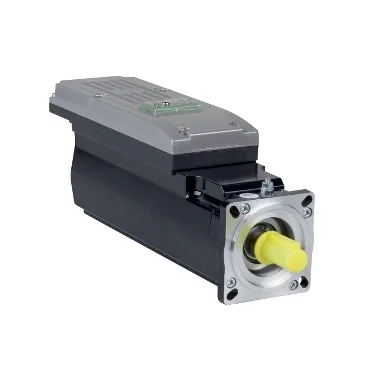
Schneider Electric PacDrive 3 ILM0702P31F0000 is a servo motor with integrated drive in the ILM family, a 70 mm flange package with a keyed shaft, IP65 sealing, and a 2.8 in (70 mm) centring collar on an international standard flange footprint — the drop-in profile for a PacDrive 3 motion cell where the cabinet space is tight and the drive electronics live on the motor back rather than in the panel. Output rating is 720 W nominal with 1.15 N.m continuous torque and a 7.6 N.m peak — the peak-to-nominal margin is roughly 6.6×, which is the ratio a sizing engineer reads when checking whether the motor can deliver a short burst for acceleration without stalling the upstream DC bus. Nominal speed is 6000 rpm, continuous stall torque 1.7 N.m and continuous stall current 2.5 A — the operating envelope is the 6000 rpm ceiling, not the peak torque figure, and the constant-torque/constant-power split is what determines whether a given gear ratio or lead-screw pitch falls inside the useful speed band.
Electrical constants a commissioning engineer actually reads
Line rated current is 1.5 A with a maximum Irms of 11.8 A and a torque constant of 0.76 N.m/A at 120 °C — the 11.8 A peak is the current ceiling the drive must deliver on demand, and the torque constant is the figure a torque-loop autotune starts from. Back-EMF constant is 48 V/krpm at 20 °C, so at 6000 rpm the generated EMF is roughly 288 V back to the drive — the DC bus has to sit comfortably above that figure under full speed, otherwise the rectifier loses headroom and the motor pulls current without producing torque. Stator resistance is 4.2 Ω phase-to-phase at 20 °C and stator inductance 19 mH phase-to-phase at the same reference — both drop with temperature to 2.92 Ω and 9.5 mH at 120 °C, which is what changes the electrical time constant and shifts the current-loop gain the drive needs to tune.
Feedback, brake and cooling — what changes a panel layout
Feedback is absolute single-turn SinCos Hiperface and the motor carries a holding brake with 3 N.m holding torque — the brake is engaged on de-energise for a vertical axis, and the single-turn absolute encoder means the drive knows position immediately at power-up without a homing move. Cooling is natural convection, no fan — the IP65 sealing covers both shaft and body, and with no fan the motor is suitable for a sealed cabinet or a washdown-adjacent zone where forced air is undesirable; the thermal limit becomes ambient plus the motor's own copper losses, not airflow. Mechanical envelope is 252 mm long with a 70 mm flange, 4 mounting holes at 5.5 mm, centring collar 60 mm × 2.5 mm deep, keyed shaft 11 mm × 23 mm — the flange matches the ILM family standard, which is what a replacement or a second-axis unit aligns to without a bracket rework. Shaft loading is constrained to a maximum radial force that steps down from 710 N at 1000 rpm to 390 N at 6000 rpm, with axial force limited to 0.2 × Fr — at 6000 rpm a belt or pinion drive has to stay under 390 N radial or bearing life shortens, which is what a coupling-versus-belt decision turns on for this frame.