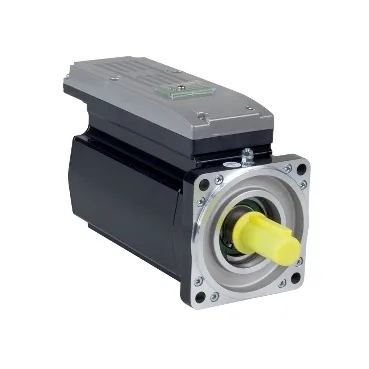
Form factor and what lands on the panel
The ILM1001P31F0000 is a servo motor integrated drive in Schneider Electric's PacDrive 3 ILM family — motor and drive electronics share one housing, so the panel-side wiring drops to a single power and feedback cable instead of the two-piece motor + standalone drive stack. The body runs 9.6 in (243 mm) long on a 3.9 in (100 mm) international standard flange with 0.4 in (9 mm) mounting holes and a 3.7 in (95 mm) centring collar — the bolt circle and shaft height match the standard IEC servo footprint, so a drop-in replacement sits on the existing machine base without re-machining. Cooling is natural convection — no fan, no auxiliary 24 V supply for a blower — which simplifies the cabinet layout in tight packaging and conveyor cells where forced-air ducting is impractical.
Torque envelope — where 600 W sits
Continuous output is 600 W with a nominal torque of 16.8 lbf.in (1.9 N·m) at 3000 rpm and a line rated current of 1.4 A; continuous stall torque is 22.1 lbf.in (2.5 N·m) at a continuous stall current of 1.8 A, sized for steady-state holding on indexing tables and small conveyors without thermal cutout at rated duty. Peak stall torque reaches 85.0 lbf.in (9.6 N·m) and the drive can pull 7.4 A Irms for transient acceleration — roughly 4.9× the continuous figure, which is the headroom that lets the axis survive a sticky load or a stall-recovery event without tripping the I²t foldback. The torque constant is 1.39 N·m/A at 248 °F (120 °C) — derate performance expectations against this figure, not against the cold 25 °C number on the nameplate, since winding resistance rises with temperature and torque-per-amp drifts with it.
Feedback, brake, and shaft details
Position feedback is an Absolute single-turn SinCos Hiperface encoder — multi-turn absolute positioning without an external battery module and a clean quadrature-style sine/cosine signal pair for the drive to interpolate. The motor ships with a holding brake and a keyed shaft end (1.6 in / 40 mm long, 0.7 in / 19 mm diameter, 1.2 in / 30 mm key width) but without a second shaft end — the rear face is sealed, not exposed, so don't expect to back-drive a remote encoder or tach from this unit.
Shaft loading limits and IP65 duty
Maximum radial force Fr is 900 N at 1000 rpm, dropping to 720 N at 2000 rpm and 630 N at 3000 rpm — oversizing a coupling or belt tension for the high-speed end is the usual mistake; pulley diameter and pre-load must respect the curve, not the nameplate headline figure. Maximum axial force Fa is capped at 0.2 × Fr — small enough that a thrust-bearing load from a ball screw or a worn pinion will preload the front bearing and shorten its life; budget the axial vector against 0.2 × Fr before mounting. The enclosure is IP65-rated, dust-tight and resistant to low-pressure water jets — fine for food-adjacent and washdown-adjacent conveyor and packaging cells, but not for full submergence or high-pressure steam cleaning.
Electrical model — stator figures for the drive engineer
Stator resistance is 9.8 Ω Ph/Ph at 68 °F (20 °C), 6.82 Ω Ph/N at 248 °F (120 °C); stator inductance is 45.7 mH Ph/Ph at 20 °C, 22.85 mH Ph/N at 120 °C — hot-side numbers, not cold-side, are what the drive's auto-tune loop wants in its motor model. Back-EMF constant is 90 V/krpm at 68 °F (20 °C) — at the 3000 rpm nominal ceiling the induced EMF reaches roughly 270 V, so a 400 V-class DC bus is comfortably above the back-EMF and the regenerative margin holds under braking transients.