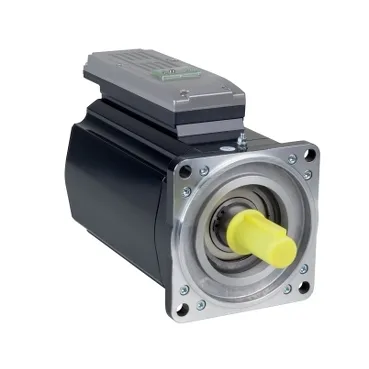
Device identity and PacDrive 3 positioning
ILM1401P31A0000 is a servo motor with an integrated drive from Schneider Electric, carrying the ILM short name within the PacDrive 3 range. The 140 mm flange and integrated-drive form factor place it as a mid-frame PacDrive 3 axis — sized for machine builders who want the drive electronics co-located with the motor rather than in a separate cabinet. Lifecycle status is recorded as current by the manufacturer, so PacDrive 3 ILM is not a phase-out line at this writing — any substitution onto a non-Schneider equivalent would need a deviation request against the customer AML rather than being treated as a routine alternate.
Torque, speed and current envelope
Continuous torque is 4.6 N.m nominal (40.7 lbf.in) and 7.5 N.m continuous stall, with a peak stall of 27 N.m for acceleration margin — sizing the load inertia against peak stall rather than nominal is what keeps the drive out of the current-limit foldback region during index moves. Nominal mechanical output is 1450 W at 3000 rpm nominal speed, with line-rated current of 2.9 A and a maximum Irms of 18.8 A available transiently — the 4.7 A continuous stall current versus the 2.9 A nominal figure confirms the motor is thermally framed around its rated operating point rather than stall.
Motor electrical constants and feedback
Back-EMF constant is 108 V/krpm at 20 °C and torque constant is 1.6 N.m/A at 120 °C — the torque constant figure is published at the operating hotspot, so the 20 °C-to-120 °C delta has to be accounted for in any cold-start torque trim. Stator resistance is 1.81 Ohm phase-to-phase at 20 °C and stator inductance 19.1 mH phase-to-phase at 20 °C, with the phase-to-neutral figures published at 120 °C — those numbers feed the drive's current-loop tuning and the I²R loss budget at sustained duty. Position feedback is an absolute single-turn SinCos Hiperface device with 128 periods of resolution, so the absolute position is retained through power cycles without a homing routine on every restart — important on machines where the operator expects the axis to resume at the last commanded position.
Mechanical envelope, shaft and mounting
Flange size is 140 mm (5.5 in) with a 254 mm (10 in) body length, a 24 mm (0.9 in) keyed shaft 50 mm long, and no brake and no second shaft end — the keyed-only configuration means any holding-torque requirement on a vertical axis has to come from the drive's regenerative stop rather than a fail-safe mechanical brake. Mounting is an international standard flange with four 11 mm mounting holes and a 130 mm centring collar 3.5 mm deep — for machine builders, that footprint matches the standard IEC 140-frame bolt pattern, so no adapter plate is needed when replacing another 140-frame servo on a rebuild.
Shaft loading, thermal and sealing
Maximum radial force Fr is rated 2210 N at 1000 rpm, derating to 1760 N at 2000 rpm and 1530 N at 3000 rpm — for a belt or pinion drive the higher end of the speed range is what actually sets the bearing-life budget, so the 1530 N figure at 3000 rpm is the one that governs a directly-coupled application running at nominal speed. Axial load Fa is limited to 0.2 × Fr, and cooling is natural convection rather than forced air — vertical or horizontal mountings with restricted airflow around the housing need a thermal verification, because the absence of a fan means the housing has to dissipate the full I²R loss through the flange and free convection.
Sourcing posture for PacDrive 3 ILM
The part is recorded at current; there is no L*-entry successor or phase-out notice on file. For contract-manufacturing builds, that means it stays on the customer's approved-vendor list without a deviation — quoting to order against the BOM through independent distribution keeps the build on the AML until a future EOL is published.