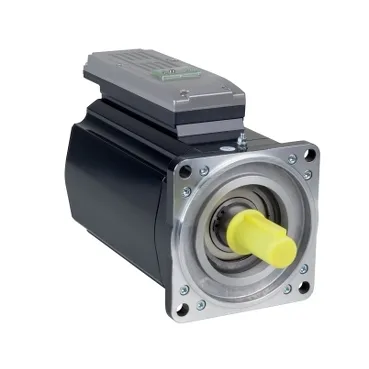
PacDrive 3 ILM — integrated servo motor in the 140 mm frame
The ILM1401P01A0000 sits in the PacDrive 3 family as a servo motor with integrated drive, sized around the 5.5 in (140 mm) flange. The short designation is ILM, and the catalog places it under Servo Drives on the line card. Lifecycle reads current on the official status field, so the motor is still being shipped as a supported PacDrive 3 component — sourcing runs through normal quote-to-order channels rather than the broker pipeline.
Torque envelope and power rating
Continuous torque is 4.6 N.m nominal, with a continuous stall of 7.5 N.m at 4.7 A and a peak stall of 27 N.m available before the drive folds back. Nominal output power is 1450 W, and the maximum RMS current the drive stage will command is 18.8 A against a 2.9 A nominal line current. The 6.5× nominal current headroom is what delivers that peak torque without saturating the field-weakening region. Nominal speed is 3000 rpm, which puts the operating point comfortably above most conveyor and packaging indexing demands and into general machine-tool territory on the upper end.
Feedback, poles, and rotor
Position feedback is an absolute single-turn SinCos Hiperface device with 128 periods of resolution. On a PacDrive 3 controller that resolves the absolute shaft position at power-up — no homing move required after every e-stop or panel swap.
Mechanical fit and shaft interface
Mounting is the international standard flange with four 11 mm holes on the 140 mm frame and a 130 mm centering collar with 3.5 mm depth. That footprint is what drops this motor into a PacDrive 3 cabinet layout without adapter plates. The shaft is 24 mm in diameter, 50 mm long, untapped, with no second shaft end and no holding brake. A 1.6 in (40 mm) keyway seats the coupling or pinion; without a brake on the motor, any axis hold requirement falls to the gearbox, the linear actuator, or a downstream mechanical brake on the driven load. Overall length is 10 in (254 mm) — that envelope drives the cabinet depth call-out at panel layout, and it is the figure to check against any existing bracket or machine cut-out before dropping the BOM line.
Shaft loads, cooling, and enclosure
Maximum radial load is rated 2210 N at 1000 rpm, stepping down to 1760 N at 2000 rpm and 1530 N at 3000 rpm; maximum axial load is capped at 0.2 × Fr. The radial envelope shrinks with speed because bearing life at constant L10 is dominated by the belt or pinion pull at the shaft — feed those numbers into the coupling selection, not the motor alone. Cooling is natural convection with IP54 sealing on the housing. IP54 keeps dust and splashing out of the windings — a clean cabinet, a packaging line away from direct hose-down zones — but it is not a washdown rating, so this is not the variant to specify on a food-grade wet end. The torque constant is 1.6 N.m/A at the 120 °C winding figure, with a back-EMF constant of 108 V/krpm at 20 °C and a stator resistance of 1.81 Ω phase-to-phase at 20 °C dropping to 1.26 Ω at 120 °C. Those three constants are what the drive's auto-commutation routine keys off during commissioning — they are also the numbers a field tech reads back through the controller to spot a winding fault before it pulls a phase.
Sourcing posture for the PacDrive 3 line
Lifecycle reads current, so the part is still moving on the official channel.