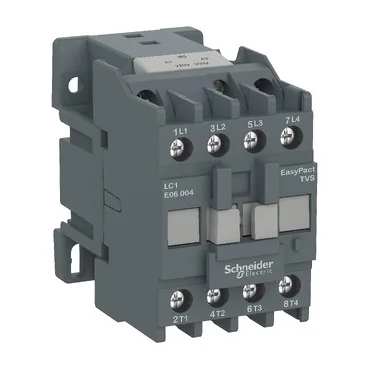
Its headline rating is 16 A at ≤440 V AC in utilisation category AC-1, which means it handles resistive heater banks, lighting, or transformer loads — not motor starting. The 4 NO (normally open) pole configuration gives you four independent switching paths, all closed when the coil is energised. The control circuit is AC at 50 Hz, wide-range, with a nominal voltage of 415 V AC. Drop-out occurs between 0.3 and 0.6 Uc, and pick-up between 0.7 and 1.25 Uc across the -5 to 55 °C range — so it stays pulled in through moderate sags but drops cleanly when the control signal is removed.
Screw-clamp terminals on both power and control circuits accept flexible wire with or without ferrules, 1 to 4 mm² range on most connections, torqued to 1.2 N·m. No auxiliary contacts are built in — if you need N/O or N/C auxiliaries for feedback or interlocking, they must be added as separate side-mount blocks.
If your load is a resistive heater bank drawing 12 A, this contactor has headroom. But if you are switching a motor (AC-3 duty), this part is not rated for that — the AC-1 category is strictly resistive. The 48 A rated breaking capacity at 440 V and 60 A making capacity tell you it can interrupt and close onto faults, but the coordination fuse (12 A gG at ≤690 V, type 1) sets the practical short-circuit protection limit. Mechanical durability is listed at 10 million cycles; electrical durability at 150,000 cycles under AC-1. For a resistive load switched once per minute, that electrical life translates to roughly 100 days of continuous 24/7 operation — fine for batch processes, but plan spares for high-duty-cycle applications. Heat dissipation runs 2 to 3 W on the control circuit and 1 W per pole, so panel thermal rise is modest.