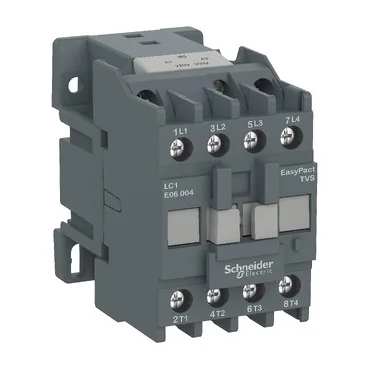
The four normally open poles make it a straight switching block for resistive heaters, lighting banks, or any load where inrush is minimal and the AC-1 curve governs contact life. Rated insulation voltage sits at 690 V, so it has headroom for 400 V line-to-line panels without derating the main insulation path.
That is not a motor-rating number — AC-1 is the resistive utilisation category per IEC 60947-4-1, so this contactor is specced for heater banks, ballast loads, or resistive furnaces where the switching arc is less aggressive than motor starting. The 415 V AC coil is a wide-range design: it picks up reliably between 0.7 and 1.25 Uc (roughly 290 to 518 V) and drops out between 0.3 and 0.6 Uc (124 to 249 V) across the -5 to 55 °C range. That wide dropout band means the contactor stays held through moderate sags but releases cleanly on a brownout. Breaking capacity is rated at 72 A at 440 V, and making capacity at 90 A at 440 V AC — both per IEC 60947. The associated fuse recommendation is 12 A gG at up to 690 V for type 1 coordination, meaning a short-circuit on the load side should blow the fuse before the contactor welds, though the contactor may need replacement after the fault. That electrical figure is the limiting number for most applications — at 20 A resistive switching, expect the contacts to need inspection around the 150k-cycle mark. Maximum operating rate is 1800 cycles per hour at 60 °C, which is fast enough for cyclic heater control but not for high-speed motor jogging.
Depth is 80 mm, height 74 mm — check gland plate clearance if the panel is shallow. IP20 protection means it is not sealed against moisture — keep it inside the enclosure, not on the machine frame. Power and control terminals are screw clamp, accepting 1 to 4 mm² flexible with cable end or solid, and 1 to 2.5 mm² flexible with cable end on the smaller side. Tightening torque is 1.2 N.m for both power and control circuits — a common value that a standard screwdriver with a torque-limiting handle will hit. The control circuit draws 95 VA inrush at 50 Hz, cos phi 0.75, with steady-state heat dissipation of 2 to 3 W. That inrush matters for transformer sizing if the coil is fed from a control transformer shared with other contactors.
Protective treatment is TH conforming to IEC 60068-2-30, which means it is treated for tropical humid environments — a useful detail if the panel ships to a coastal or high-humidity site.