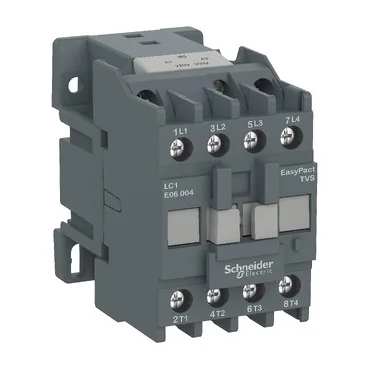
Its 25 A rated operational current at ≤415 V AC (at <40 °C) means it handles heater banks, lighting, or other non-inductive loads up to that current — not motor starting, which would need an AC-3 rated contactor. The 415 V AC 50 Hz coil is wide-range, so it pulls in reliably between 0.7 and 1.25 times Uc and drops out between 0.3 and 0.6 times Uc across -5 to 55 °C. With 4 normally-open poles and no auxiliary contacts built in, this contactor is a straight power-switching device — you add a separate auxiliary block if you need feedback or interlocking. The screw-clamp terminals accept up to 6 mm² solid or 4 mm² flexible with ferrules, tightened to 1.2 N.m on both power and control circuits.
Operating altitude up to 3000 m covers most sites without derating.
The 25 A AC-1 rating is the headline number, but the breaking capacity tells you more about fault handling: 72 A at 440 V per IEC 60947, and a making capacity of 90 A at 440 V AC. That's the contactor's ability to close onto and interrupt a fault — not something you'd design for, but it confirms the part can survive a downstream short without welding shut, provided the upstream fuse (12 A gG at ≤690 V, coordination type 1) clears the fault. Electrical durability is 150,000 cycles at AC-1 — that's the resistive-load life. Mechanical durability is 10 million cycles, so in a low-current signalling application it'll outlast the panel. The 1.6 W dissipation per pole at AC-1 means the total heat load inside the enclosure is about 6.4 W for all four poles, plus 2 to 3 W from the coil — negligible for most cabinets.