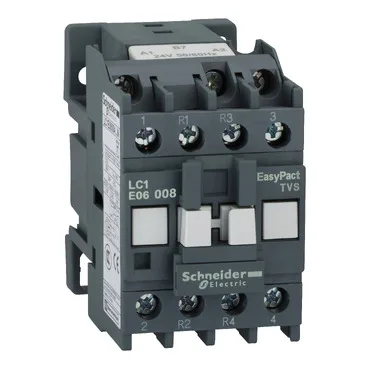
The coil is a wide-range AC type at 415 V 50 Hz, with a dropout threshold of 0.3 to 0.6 Uc and an operational range of 0.7 to 1.25 Uc across -5 to 55 °C — so it holds in nicely during brownout conditions but drops cleanly when the control signal goes low. It carries no built-in auxiliary contacts, so you'll need to add a separate auxiliary block if you want feedback or interlocking.
The 45 mm width and 80 mm depth keep the footprint tight for a 4-pole unit. Connections are screw-clamp terminals — power circuit accepts 1 to 6 mm² solid or 1 to 4 mm² flexible with ferrules; control circuit takes 1 to 6 mm² solid or 1 to 4 mm² flexible. Torque both circuits to 1.2 N.m. IP20 protection means the contactor is safe from finger contact but not for washdown — keep it inside the enclosure.
What the ratings mean in practice
The AC-1 utilisation category tells you this contactor is optimised for resistive loads — think heaters, incandescent lighting, or transformer primary switching where the inrush is low. The rated breaking capacity of 96 A at 440 V and making capacity of 120 A at 440 V give you headroom for occasional overloads during fault clearing. Electrical durability is 300,000 cycles under AC-1, and mechanical durability is 10 million cycles — so in a heater-bank application cycling a few times an hour, the electrical life will be the limiting factor.