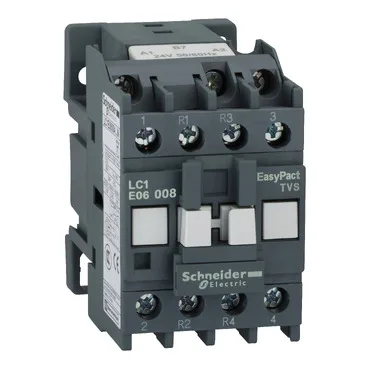
It's rated for AC-1 utilisation category at 32 A up to 415 V, meaning it's designed for resistive loads like heaters or lighting banks — not motor starting. The AC-1 rating is the thermal current the main poles can carry continuously in a resistive circuit; if you're switching inductive loads, you'd need the AC-3 or AC-4 rating, which this part doesn't carry.
Mounts on a plate or DIN rail — 45 mm wide, 74 mm tall, 80 mm deep. That's a standard 4-pole contactor footprint; fits a typical 45 mm DIN slot. Rated for operation up to 3000 m altitude and -5 to 55 °C ambient, with storage down to -60 °C.
This part is marked obsolete by the manufacturer. If you're freezing a new design, look at the current Easy TeSys or TeSys Deca range for an active equivalent; the 4-pole 32 A AC-1 form factor is common, but pinout and auxiliary wiring should be verified against the panel layout.
Mechanical robustness: 1.5 Gn vibration open, 3 Gn closed; shock rated 7 Gn open, 10 Gn closed.
Switching timing note
That matters if you're using the NC pole for a safety interlock or a feedback signal — the break-before-make window is tight but specified, so you can time downstream logic accordingly.