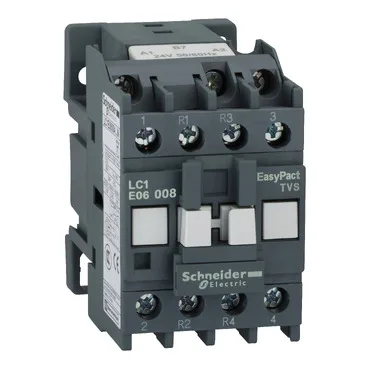
It's rated for AC-1 utilisation category at 32 A with a maximum operational voltage of 415 V, and carries a 380 V coil. This puts it squarely in resistive-load switching — heaters, lighting banks, non-inductive elements — not motor starting. It's built to EN/IEC 60947-1, 60947-4-1, and 60947-5-1, plus the Chinese GB/T equivalents, so it was designed for global panel builds where those standards are the baseline. Mounts on DIN rail or plate. IP2X finger protection — fine inside a locked cabinet, not for open-panel washdown areas. Rated for operation up to 3000 m altitude and ambient temps from -20 to 70 °C at the coil, with storage down to -60 °C.
The AC-1 rating of 32 A is the continuous resistive current the main poles can carry and break. If you're switching motor loads (AC-3), this contactor is not the right tool — the make-and-break on inductive inrush would exceed its design. Stick to resistive or slightly inductive loads like power-factor correction capacitor banks (with appropriate derating). Mechanical robustness is specified: 1.5 Gn vibration tolerance with contacts closed, 3 Gn when open; shock rated to 10 Gn closed, 7 Gn open. That's enough for most industrial panel environments but not for direct mounting on a high-vibration machine frame without additional damping.