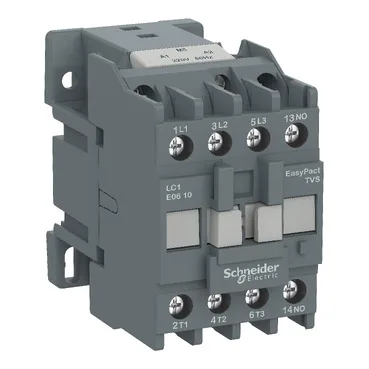
The coil is 110 V AC at 60 Hz, and it includes one normally-closed auxiliary contact.
The AC-1 rating covers resistive loads like heaters at a higher current, but for motor duty the AC-3 figure is the binding spec. The 1.5 ms non-overlap time between NC and NO contacts ensures the auxiliary circuit breaks before the main poles close, which matters for reversing or star-delta schemes where overlapping could short phases. The coil is 110 V AC at 60 Hz only — not a 50/60 Hz dual-frequency coil. If your control voltage is 110 V at 50 Hz or 220 V at either frequency, this contactor will not pull in reliably. Verify the control transformer matches 110 V 60 Hz before committing the BOM line.
A direct parametric substitute would need the same 3-pole, 12 A AC-3, 110 V AC 60 Hz coil, 1NC auxiliary, and DIN-rail footprint — but that is a cross-reference you would need to validate against your panel layout and control voltage.
It also meets EN/IEC 60335-1 Clause 30.2 and EN/IEC 60335-2-40 Annex JJ for appliance applications. Ambient temperature range is -20 to 70 °C at the coil, with storage from -60 to 80 °C and operation from -5 to 55 °C. Mechanical robustness is specified for vibration (1.5 Gn open, 3 Gn closed) and shock (7 Gn open, 10 Gn closed) — figures that confirm it holds up on a machine-mounted panel.