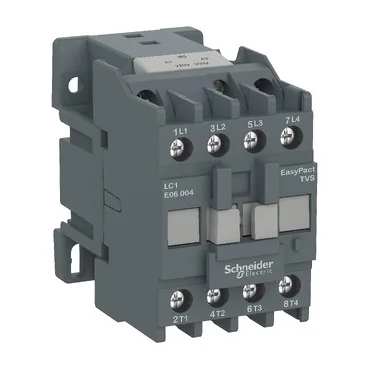
The 4 NO (normally open) pole composition means all four poles close when the coil is energised; there are no built-in auxiliary contacts, so any feedback or interlocking requires an external auxiliary block. The control circuit is AC at 50 Hz, wide-range, with a nominal voltage of 220 V AC. The pickup range is 0.7 to 1.25 Uc (154–275 V AC) at -5 to 55 °C; dropout occurs between 0.3 and 0.6 Uc (66–132 V AC). Inrush power at pickup is 95 VA at cos φ 0.75, with steady-state heat dissipation of 2–3 W in the control circuit. This matters for transformer sizing in a panel — a 100 VA control transformer can comfortably handle the inrush of this contactor plus a few small loads. IP20 protection means it is finger-safe for panel installation but not protected against moisture ingress — keep it inside an enclosure rated for the environment.
Where it is used and how it performs
This contactor is designed for resistive load switching in control panels — think heater banks, lighting contactor panels, or resistive ballast switching. The AC-1 utilisation category governs the rating: 32 A at ≤440 V AC is the thermal current (Ith) for the power circuit, with an average impedance of 2.5 mΩ per pole at 50 Hz. Power dissipation per pole is 2.6 W in AC-1 duty, so four poles running at full load dissipate about 10.4 W — factor that into enclosure thermal calculations. Operating altitude is 3,000 m without derating.