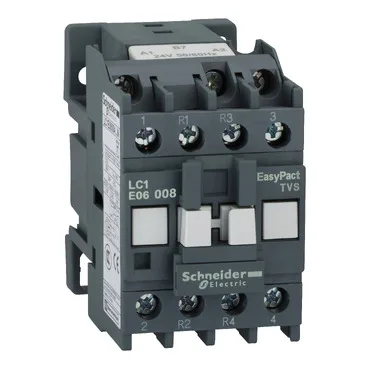
Its headline rating is 40 A at up to 415 V AC, which means it handles resistive heating loads, lighting banks, or other non-inductive circuits at that current — not motor starting, which would fall under AC-3 duty. The coil is a 415 V AC 50 Hz wide-range type, with a pickup range of 0.7 to 1.25 Uc and a dropout range of 0.3 to 0.6 Uc across -5 to 55 °C, so it stays pulled in through moderate sags but drops out cleanly on undervoltage.
The 40 A AC-1 rating at ≤ 415 V is the operational current for resistive loads. The rated breaking capacity is 144 A at 440 V, and the rated making capacity is 180 A at 440 V AC — both per IEC 60947 — so it can close into and interrupt overloads well above its continuous rating. The contact configuration is 2 NO + 2 NC, giving flexibility for both power and auxiliary switching without an add-on block. The 4-pole design (4P) suits applications needing simultaneous switching of multiple phases or separate load circuits. The operating altitude of 3000 m covers most installations without derating.
Integration notes
The contactor occupies 45 mm width on a DIN rail, with a depth of 80 mm and height of 74 mm — a compact footprint for a 4-pole 40 A device. Screw clamp terminals accept up to 6 mm² solid or 4 mm² flexible with ferrules on the power circuit, and 4 mm² on the control circuit. Tightening torque is 1.2 N.m for both power and control terminals. The coil draws 95 VA inrush at 50 Hz, so factor that into control transformer sizing if multiple contactors pull in simultaneously. Heat dissipation is 2 to 3 W for the control circuit and 2.6 W per pole under AC-1 load — enough to consider ventilation in a densely packed enclosure.