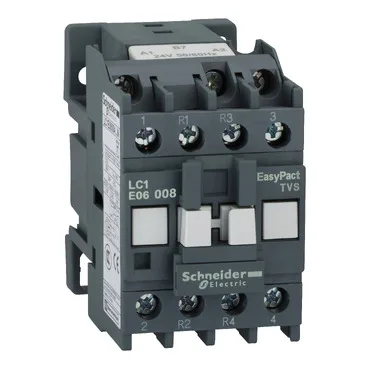
What this contactor is — and what it's not
Its AC-1 utilisation category means it's designed for resistive loads. The rated operational voltage on the power circuit is ≤415 V, and it carries a 40 A rating in that duty. If you're sourcing this for a motor load, stop: AC-3 (inductive motor duty) is a different rating curve, and this part doesn't carry one on record.
Mounting and integration notes
Mounts on a plate or DIN rail. The footprint is 45 mm wide by 74 mm tall by 80 mm deep. IP2X protection means it's finger-safe from the front but not sealed against dust or moisture; keep it inside an enclosure.
The AC-1 rating of 40 A at ≤415 V tells you the continuous current-carrying capacity for resistive loads. That's the number that governs the contactor's thermal sizing — don't derate it for motor inrush unless you know the AC-3 value (which isn't listed here). The non-overlap time of 1.5 ms between NC and NO contacts on both energisation and de-energisation is a safety feature: it guarantees that the NC and NO poles never close simultaneously during transition, which matters if you're using the NC for a safety feedback loop and the NO for the load circuit.
Standards and environmental limits
Operating altitude up to 3000 m without derating, and the permissible ambient temperature range is -5 °C to +55 °C for operation, with storage from -60 °C to +80 °C.