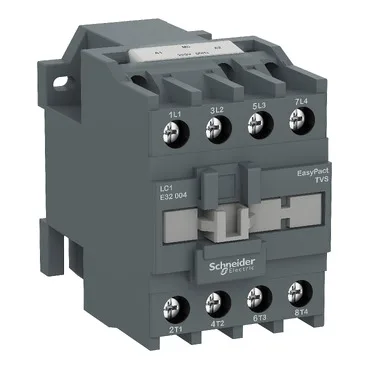
It is rated for 50 A operational current in AC-1 utilisation category at ≤415 V AC, meaning it is sized for resistive load switching — heaters, lighting banks, or other non-inductive circuits where the current waveform stays near sinusoidal. The 220 V AC 50 Hz coil draws 95 VA inrush at 20 °C, with a hold dissipation of 2 to 3 W on the control circuit. The 4 NO pole arrangement gives you four independent switching paths that close together, so one contactor can switch a three-phase resistive load plus a neutral, or four separate single-phase circuits. There are no auxiliary contacts built in — the auxiliary contact composition is listed as without, so any feedback or interlock signals require a separate add-on block.
The headline rating is 50 A at ≤415 V AC in AC-1 duty. This is the continuous resistive load the contactor can carry and break. For motor loads (AC-3 category) the rating will be lower — this part is not specified for AC-3, so if you are switching a motor directly, look at the TeSys D or F range instead. The rated breaking capacity is 200 A at 440 V, and the rated making capacity is 250 A at 440 V AC, both per IEC 60947-4-1, which covers the inrush and fault-clearing capability for the power circuit. The control circuit voltage limits are specified: drop-out occurs at 0.3 to 0.6 Uc (66 to 132 V AC) across -5 to 55 °C, and pick-up requires 0.7 to 1.25 Uc (154 to 275 V AC) across the same range. This means the coil will hold in through a moderate brownout but drops out cleanly below about 66 V, preventing contact welding on undervoltage recovery. The operating time is 12 to 22 ms on closing and 4 to 19 ms on opening — tight enough for sequencing in a panel without nuisance overlap.
The screw clamp terminals on the power circuit accept 1 to 10 mm² solid or 1 to 6 mm² flexible with cable end; control circuit terminals accept 1 to 4 mm². Tightening torque is 1.5 N·m on power terminals, 1.2 N·m on control. The operating altitude goes to 3000 m without derating, and the overvoltage category III rating suits fixed-installation distribution panels downstream of the main breaker. Fire resistance is 850 °C per IEC 60695-2-1, which is the glow-wire test for flammability — relevant for panel certification in some jurisdictions.
It also carries the Chinese GB/T equivalents. The protective treatment is TH conforming to IEC 60068, which is the tropicalisation treatment for heat and humidity resistance — relevant if the panel ships to a coastal or high-humidity site.